
To be fair, there are a lot of Freddie Hubbard live sets available, both “unofficial” and recorded from radio broadcasts; most are from his CTI or later period. Searching on Discogs for official or bootleg releases is a thankless task, with as many as 42 releases if you include reissues that feature an additional live track, and compilations with a live track or two. Again, though, they are almost all from post-1968.
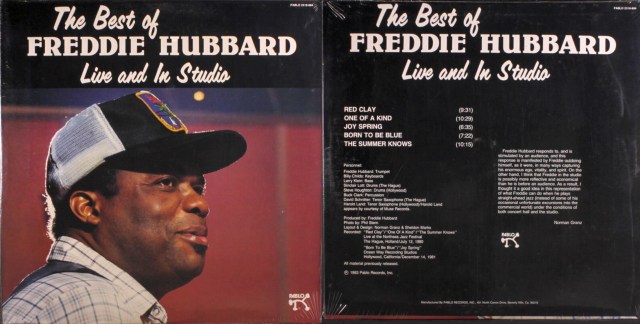
Even Norman Granz pulled a Hubbard live set featuring “Red Clay” for his Pueblo label in 1983. “Live And In Studio” isn’t a bad album, it’s just barely a Freddie Hubbard album. The earliest live set I have is from 1972, a complete recording from the Boston Jazz Workshop. Kim Paris posted a version of this to the FM Radio Archive [1]https://archive.org/details/freddie-hubbard-boston-jazz-workshop-1972-73.
It’s good news then that Resonance Records has put together an official release of Freddie Hubbard captured live on April 10, 1967, at the Blue Morocco jazz club in The Bronx, NY, featuring Bennie Maupin, Kenny Barron, Herbie Lewis, and Freddie Waits.
In 1967, Sylvia’s “Blue Morocco” was described in the New York Amsterdam News as “one of the most swinging places in the Bronx.” – The club was at 1185 Boston Rd. in the Williamsbridge neighborhood of the Bronx. Like many of New York’s small club venues, the club is no longer there; today it is the location of a credit union. I could find no contemporary ads’ or reviews for the show. A month later, the “Incredible” Jimmy Smith would appear on May 4-7, three shows per night. Back in January, Hubbard’s Quintet had been at Slug’s East Village Jazz Club.
In February, Freddie had appeared in a Living Music jazz concert in a group called “The Urbanites”. On February 15th, they performed at the Countee Cullen Library auditorium. The library is at 104 W 136th Street in the Bronx. Members of the group were Sam Rivers, tenor saxophone; Freddie Hubbard, trumpet; Scotty Holt, bass; Joe Chambers, drums; and William Andrew Hill, piano. Their program included “Compulsion,” “Legacy,” “Moonchile,” and “Heritage.” Entrance was, as with all New York Public Library events, free!
At the end of April 1967, the Freddie Hubbard Quintet would appear at the “2nd Unity Bazaar,” a giant trade fair sponsored by Muhammad’s Mosque No. 7 and held at Empire Rollerdrome, 200 Empire Road in Brooklyn, NY. The Unity Bazaar (Trade
Fair) sponsored by the Muslims was designed “to promote community support for the black businessman, artist, and craftsman by displaying their goods, products, and professional services.” The next day, Sunday, April 30th, they would appear at the Olatunji Center for African Culture from 4 to 8 p.m.
Freddie Hubbard wouldn’t record until November 1967, when he cut three tracks for his 1968 hard bop Atlantic Records album “High Pressure Blues,” which wouldn’t be finalized and released until 1968. Making the live “Blue Morocco” set important in the evolution of Hubs.
Blue Note did release his “Blue Spirits” album in 1967, but that consisted entirely of sessions from two years earlier. In their review of the album, Downbeat noted, “Hubbard’s playing is sometimes over-frantic, but this fault is relatively minor when his virtues are considered.”
Here without further ado, here is the Hubbard live set from 1967; you can stream, buy digital, or purchase a physical 2x CD set from Bandcamp.
The full Bandcamp release page is here [2]https://freddiehubbard.bandcamp.com/album/on-fire-live-from-the-blue-morocco
References
Discover more from Creed Taylor Produced
Subscribe to get the latest posts sent to your email.
Mark, thanks for showcasing this new release of Freddie Hubbard at the Blue Morocco, and for posting a link to the Boston Jazz Workshop set on FM Radio Archive. I wanted to alert you to the other Freddie Hubbard broadcast recordings on FM Radio Archive, there are 3 more in addition to the Boston Jazz Workshop show: https://archive.org/details/fmradioarchive?tab=collection&query=freddie+hubbard&and%5B%5D=subject%3A%22Freddie+Hubbard%22
I hope you and your readers enjoy these glimpses into Freddie Hubbard at his peak, from 1972 to 1984. Thanks, Kim Paris, FM Radio Archive