
On This day, January 15th, I’m remembering the legendary Jack Teagarden who passed-on 61-years ago. Perhaps one of the most overlooked series of albums Creed Taylor produced were the four albums in 1961 and 1962 he recorded with Jack Teagarden for Verve. One of them was a soundtrack for the NBC Special Projects Television Series, “America’s Music”; the other three were Teagarden-led albums. What made these even more prophetic was that they were the last ever studio recordings made by Teagarden.
In many ways, the albums are unremarkable, yet they are strangely hypnotic as modern recordings in stereo. They capture a truly remarkable trombone player and vocalist in his final recordings. The albums are both mellow and tuneful, carried by Teagarden’s relaxed and effortless vocals, with a great sense of phrasing and timing.
This is one of the longer pieces I’ve written here. I will add an audiobook style version to youtube when complete. I also have a unique laserdisc conversion of Teagarden performing a set of studio recorded numbers which I will also add youtube. The ctproduced channel is here, please like and subscribe.
Preamble
If a definitive guide to jazz could be written and include the top 10 players, Teagarden deserves to be among them. He suffered as many, if not more, setbacks in the music business than anyone. When I decided to write about Teagarden, as with many of my other biographical sketches, I didn’t want to simply repeat what others have written. There are a few books on Teagarden, most written toward the end of his career but before he recorded with Creed Taylor and Teagarden’s death just months later.
Teagarden was, in some ways, the embodiment of Jazz. Listening to the albums recorded and produced by Creed Taylor, you can easily imagine them fitting into any number of genres, even the chill-out era of the early 2000s. Teagarden’s effortless freewheeling improvisation; the unforced switch from trombone to vocals and back just slips through the grooves like a duet. This was Teagarden, not some fancy computer-controlled multitracking, just a man who honed his skill over 50 years.
For example, it’s mostly ignored that Teagarden was a self-taught engineer who actually has a number of design patents to his name; Teagarden, through the forties and fifties, often had run-ins with the American Federation of Musicians over fees and practices; equally, he was at the forefront of many advances that benefited the community. Those are some of the topics I’ll cover.
It is also worth remembering that a 15-year-old Stan Getz left school at fifteen to join the band of Dick Rogers, returned to classes, and then went on the road again the next year with Jack Teagarden, who was charged with watching over the boy and became, in effect, Getz’s guardian. Getz later expressed appreciation and thanked the traditional jazzman for the insight and respect for the foundations of jazz [1]Nat Hentoff, International Musician magazine – May 1961.
While Teagarden’s original 78 and 10″ album recordings are evocative in mono and hit exactly the right note for their vintage, the Verve albums — masterfully recorded by Rudy Van Gelder and Ray Hall and produced by Creed Taylor—just slide into today. Creed Taylor successfully reinvigorated the careers of many jazz musicians, and Teagarden should have been among them; except he would die just short of a year after the last album was released, sick, alone, and still on the road when he should have been in a hospital.
When Verve’s a&r director, Creed Taylor, caught the Big Gate[One of Teagarden’s nicknames] in Chicago late in June [’61], he found the trombonist-leader in a mellow mood. He had accumulated a group of obscure tunes had pleased him in the past and bore a certain significance in his long career.
MIS’RY AND THE BLUES – V6-8416 – George Hoefer
When Marc Myers (jazzwax.com) asked Creed about Teagarden, Creed replied:
“What an artist. Jack made it look so easy. Most people are unaware that he used unusual slide positions on the trombone because his arms were short. His vocals were sensational. Yet he was so quiet when he wasn’t playing. He really didn’t talk much.”
Creed Taylor Interviewed by Marc Myers in May 2008 [2]https://www.jazzwax.com/2008/05/interview-cre-3.html
Writing in Jazz Journal, Steve Voce said: “Teagarden is probably the most gigantic of all the giants of jazz – an acknowledged leader on his instrument and an inventor of great brilliance and technical accomplishment.”
Taylor has spoken affectionately about his time as a teen listening to Symphony Sid and his broadcasts from Birdland on a radio in his bedroom. I couldn’t find definitive listings, but there is no doubt Teagarden would have appeared regularly on the Symphony Sid show either as a leader or in one of the major bands of the time.
Jack Teagarden was born in Vernon, Texas, in 1905. Vernon, a town of some 11,000 people in north Texas, is just north of Wichita Falls on the road (287) to Amarillo. Normally this wouldn’t be worth mentioning, except for the fact that Roy Orbison was also born in Vernon in 1936, and would have definitely been able to tell Tony Christie “the way to” Amarillo [3]https://en.wikipedia.org/wiki/(Is_This_the_Way_to)_Amarillo.
Teagarden first arrived in New York in 1927, aged just twenty-two. What followed was a remarkable career. Teagarden, from a musical family, would go on to have his own big band and play with pretty much everyone who was anything in jazz right up to his death. He featured in bands and films with Bing Crosby, and after the collapse of the big band era, Crosby would bring Teagarden back to New York where he would renew his longtime partnership with Louis “Satchmo” Armstrong. Teagarden and Crosby had both been in Paul Whiteman’s orchestra in the late 1920s and early 1930s.
Teagarden And Taylor
After decades of mismanagement, losses, bankruptcy, divorce and being somewhat forgotten as musical taste changed, Teagarden was presented with an opportunity to record with the then hot-shot, up-coming producer, Creed Taylor. It’s not clear why or how this came about, most likely a little of this and a little of that. What is clear is that Creed jumped at the chance.
In 1954, Norman Granz had in essence built Verve around Ella Fitzgerald. Granz had also joined up with artist manager and sometime promoter Joe Glaser for the “Jazz At The Philharmonic (JATP)” shows. Granz signed with Glaser to promote a tour that started in Los Angeles and continued to San Diego, San Francisco, Victoria – British Columbia. In addition to Armstrong, Joe Glaser was manager to Billie Holiday and Duke Ellington and “scores” of others handled by his Advance Booking Company. Granz and Glaser would continue to cross swords and cooperate until Granz sold Verve. By that time, Louis Armstrong was also signed to Verve(1956).
Teagarden, by the early 1960s, was also represented by Joe Glaser’s Advanced Booking Company (ABC). Glaser had taken Louis Armstrong under his wing in the late 1920s and early 1930s and would remain Armstrong’s manager until Glaser died in 1969. Glaser was a mob-linked booking manager and representative.
One of Glaser’s protégés was Clarence Avant, then a personal manager. Yes, Clarence Avant, who would go on to be President of Motown and negotiate with Herb Alpert and, more importantly, Jerry Moss for the CTI Jazz production agreement with Creed Taylor in 1966-67. [4]I have an articles on both Joe Glaser and Clarence Avant in draft form and hope to publish them both in 2025.[5]https://en.wikipedia.org/wiki/Joe_Glaser.
George Hoefer writing the first in a series of profiles of jazz record producers, said of Taylor “Taylor did two LPs with Teagarden singing and playing the songs he himself [Taylor] wanted to record. One album contained all Willard Robison compositions. Now that Jack is gone, the Verve catalogue has a valuable Teagarden legacy in its files.” [6]Jazz Magazine – January 1965 Vol 4 No 1, Pg21
“Jazz Great”
Recorded: November 12th-13th, 1954.
Released: BCP-32 – January, 1957; re-released January 1958 as “Dixie At It’s Best”; re-released in 1978 as BCP-6040 “Meet Me Where They Play The Blues”.
In November 1954 Teagarden had been in New York, he recorded a number of tracks at Esoteric Sound Studios at 238 E. 26th St. The session included Leonard Feather, who wrote one track, played piano and also wrote the liner notes. Leonard Feather and Creed would form an important bond over the coming years. I had wondered if Taylor had produced the sessions?
At the time, Bethlehem wasn’t putting producer credits on the sleeves. Marty Paich was producing Mel Tormé as he transitioned from pop to jazz and Taylor was responsible for all the east coast sessions and jazz-artists. In mid-1955, when Taylor left Bethlehem, Red Clyde became responsible for A&R, including Fran (Francis) Faye and the west coast.
Strangely despite being recorded shortly after Creed arrived at Bethlehem, the album wasn’t released until after Creed had left.
The liner notes for the 1978 reissue by Feather cleared up any lingering doubt. Feather himself says that “I made arrangements with a small independent company, Period Records, to produce three sessions, each with different personnel, for release on two 10-inch LPs.” [7]Cover notes, BCP 6040 Bethlehem – Jack Teagarden – “Meet Me Where They Play The Blues” – Two years after the recording, it was announced that “Bethlehem Records has purchased 10 masters from Period Records, to be issued under the Bethlehem name. Scheduled for immediate release is a 12″ LP by Jack Teagarden.” [8]Down Beat – November 14th, 1956 Pg46
So, the Teagarden album that wasn’t Creed’s.
Perhaps a coincidence that track-1 on side-2 was indeed Charlie LaVere’s “Misery and the blues”, a variation of which would be the the title of Teagarden’s first album with Creed Taylor.
The contract Teagarden would sign with Verve and Creed Taylor would be the last of Teagardens long and storied career. Nearly forty years after Teagarden recorded his first records with Willard Robison in New York City, Taylor would capture four remarkable albums two in studio stereo and a third big band set with overdubs where the sound wasn’t as Taylor wanted.
“Mis’ry And The Blues”

Recorded: June 18-22, 1961 – Chicago
Released: Late 1961 in stereo(V6-8416) and mono(V-8416) 12″ Vinyl – Verve Records
Verve VSTC257 (4 -track stereo tape)
Europe and USA Stereo CD 2003 V6-8416

I actually have three versions of this album, stereo 12″ album pressing; a 7 1/2 inch per-second reel-to-reel tape and an unusual and somewhat rare version of the album on 5x 7″ singles which run at 33 1/3 and was issued in 1963. The February 1963 issue of Billboard confusingly listed the jukebox release as “pop instrumental”.
Clipping: Down Beat January 4th, 1962, Pg34 – Stereo Tape Review.

After reading Downbeat editor Don DeMicheal’s comment and review, I had to go back and listen to all three. At least to my ears, the singles version is a better mix, but I don’t hear the issue DeMichael does on the vinyl album mix. My favorite review of the album comes from the December 1961 issue of Audio magazine. The review of the tape version describes it thus:
Stereo tape turns the burnished brass in this mother lode to pure gold, and Jack Teagarlen’s trombone never glowed with a more mellow sound. And no trumpeter more reliable and steady than Don Goldie has partnered Big T since brother Charlie was a constant companion.
If anything, Goldie is a performer of even greater versatility. with the exciting tone of Bix Beiderbecke, the blues cry of king Oliver, and the reserve strength of an Armstrong. Goldie matches the trombonist to perfection, and his featured solo has all the romantic warmth of a Billy Butterfield on the lazy Afternoon In August, a melodic interlude written by the sextet’s clarinetist, Bill Stegmeyer.
Sharing honors with the brass team are two pianists, one a working member and the other guest arranger and composer. Don Ewell, who heads the rhythm section of Stan Puls, bass. and drummer Barrett Deems, shines brightly on King Oliver’s Froggie Moore. Charlie La Vere, who once guided the notorious Chicago Loopers gang, met Teagarden when they both worked for Paul Whiteman, and the attractive title time is entirely his doing.
Among his other goodies unwrapped during the reunion are arrangements of Willard Robison’s Don’t Tell A Man About His Woman, and Terry Shand’s Lore Lies. The lovely Shand melody receives unusual treatment, with organist ‘Shay Torrent suppling a firm underpinning of sustained organ chords. The instrument is right at home in a jazz context for once, and the stereo effect Infinitely enjoyable. The leader’s voice is in fine form, especially during a reprise of Basin Street Blues.
CHARLES A. ROBERTSON, Jazz and all that – Audio magazine, December 1961
The album was listed as a “Recording of Special Merit” in the February 1962 issue of HIFI Stereo magazine and in his review, Nat Hentoff said “Teagarden’s solos are so distinguished for their warmth, economy of structure, and fully mature individuality that they compensate for the predictable backgrounds. His singing remains a model of jazz vocalizing at its best-illuminating phrasing; unself-conscious, swinging pulsation; uniquely expressive timbre; and projection of spontaneity.”
Nat Hentoff went on to say that “a record label should arrange one more reunion of Teagarden, Louis Armstrong, Edmond Hall and Earl Hines. In the meantime, I am grateful for whatever Teagarden appears on record because the man is incapable of a poor performance.” [9]HIFI/STEREO February 1962, Pg90
This made me wonder, what are the top-10 Teagarden tracks. I don’t hold much stock by Spotify, there are to many ways it seems unfair; the system can be gamed or is worse still, just getting scammed. That’s a topic for later. I did look up to see the top-10 Teagarden tracks according to Spotify and two of the tracks from this album are included “Afternoon In August” (Instrumental) and “Basin Street Blues”.
There are many tracks that are called Teagarden’s “signature” songs, writing in “Classic Jazz” [10]Classic jazz : a personal view of the music and the musicians – University of California Press, ISBN 0-520-21360-2 – Floyd Levin says “Loves Lies”, which Taylor captured on “Mis’ry And The Blues”. Richard Gurdens writing in “Bing Crosby – crooner of the century” quotes Arvell Shaw saying “I liked to sing the songs Jack Teagarden played, and I would back him on bass. He sang “Stars Fell on Alabama,” his signature theme, ‘‘After You’ve Gone.” and my favorite “A Hundred Years from Today.’ Like Louis, Jack was one of the great musicians.”
Willard Robison’s Deep River Orchestra showcased Teagarden’s trombone in 1924, leading to a close friendship and mutual respect between Teagarden and Robison. In 1927, Robison supported Teagarden financially by involving him in recording sessions. Robison’s sentimental ballads are likened to Stephen Foster’s classics, including “Don’t Tell A Man About His Woman” and “Peaceful Valley.” Although Taylor didn’t record Shaw’s selections, he covered Teagarden’s well-known tracks like “Basin Street Blues” and “Mis’ry And The Blues.”
Taylor and Teagarden would return to Willard Robison’s writing in the third album, but first a TV special recording, or rather not.
“Chicago And All That Jazz”
Not available from most streaming services, above is an embed to stream from the Internet Archive.


Recorded: October 30 & 31, 1961 – Webster Hall, New York City – Ray Hall, Engineer
Released: V/V6-8441, VLP 9003 – December, 1961; Also released in UK(1962) and in 1974 Verve Records – 2683 051 combined with the 1958 album “Eddie Condon Is Uptown Now!” (MGM E3651) into a double album with with a red cover with very similar wording to celebrate the 1973 passing of Eddie Condon. [11]https://www.discogs.com/release/2025321-Eddie-Condon-Max-Kaminsky-Chicago-And-All-That-Jazz
Verve Records – VSTC 266 – Reel-To-Reel, 7 ½ ips, ¼”, 4-Track Stereo
Lone Hill Jazz – LHJ10370 (CD) 2009 combined with the earlier 1961 Roulette album “The Dixie Sound Of Jack Teagarden” with a Chuck Stewart cover picture and issued only in Europe.
On October 30, 1961, musicians reunited for the first time in thirty-four years at Webster Hall after an NBC rehearsal, fully aware of the occasion’s significance, with Eddie Condon stating that they were there solely to play music. The program would be the “DuPont Show Of The Week” which was televised over the NBC-TV network on Sunday 26th of November, 1961.
The album though, isn’t a live recording of the show. The album features Joe Sullivan, Jack Teagarden, Pee Wee Russell, Jimmy McPartland, Gene Krupa, Bob Haggart, Bud Freeman, and Eddie Condon—all of whom appeared on the TV show. It did not, though, include everyone featured in the show. This was because no record company was involved with the show, which also explains why the sound recording of the show was in mono.
The artists rehearsed all day Monday, recorded all Monday night; Taped the show on Tuesday and went back to the studio to finish recording Tuesday night. This gave rise to the 50-hour story, “They went 50-hours without any sleep.” [12]TV Scout column, Philadelphia Daily News – Fri, Dec 8, 1961, Pg67 – Cash Box also reported the album would be in the stores by the XMAS Rush” [13]Verve Rushes LP On Jazz TV’er” – Cash Box magazine – November 25th, 1961 and December 16th, 1961.
The show was available on a VHS tape, mono sound, black and white picture on a 1991, Jazz Vintage Classics Video [14]As of writing there was one copy, still sealed for sale on ebay.. Luckily it has already been posted in youtube [15]https://www.youtube.com/watch?v=9szX2cQyej4. [16]Franz Hoffman who has compiled two comprehensive volumes, one “Jazz On Film And TV” and the second on “Jazz Advertised” includes the following in his latest “Jazz On … Continue reading
The Album Sessions
I have not been to Webster Hall in over a decade, but the same basic shell is there. It is such a legendary location and around this time so many of the epic Creed Taylor albums were recorded there including Stan Getz- “Focus”; Stan Getz With Laurindo Almeida; Of course, Jazz Samba Encore was recorded at Webster Hall as well.
Also recorded there was Bill Evans – Trio ’64; “The Individualism Of Gil Evans”; and perhaps most importantly, as we approach the 62nd anniversary, on February 6th, of the recording of Bill Evans “Conversations With Myself” [17]http://ctproduced.com/otd-conversations-with-myself/.
John Wilson review in Down Beat was somewhat late, in the February 15th, 1962 issue, wrote:
Part of the cast of the TV production Chicago and All That Jazz was spirited away from rehearsals for that show to a recording studio to make this disc. The results, in light of the show, suggest they did their best playing for the record.
Teagarden, in particular, projects tremendous strength, vitality, and general joie de vivre both on his horn and in his singing. Freeman comes on with a keen-edged, lusty attack that should make the current tenor stars reconsider their stature. Sullivan rollicks across the piano like a great, sure-footed bear. And Russell is simply magnificent in his tightly etched eloquence. Furthermore, anyone who has wondered if Condon really does play any thing when he sits up there strumming his guitar can hear exactly what he is doing all through this set—which is quite aplenty both in rolling the rhythm along and, in one notable instance, giving Russell a tremendous, running shove into a solo.
Two short piano solos by Miss Armstrong and a pair of numbers in which she, Miss Seeley, and Teagarden share the vocal honors (if that is the appropriate word) are out of place both as regards context and quality.
But the rest is just about the best display of up-dated Chicago-Condon style jazz that has been recorded yet. [18]John Wilson review – Down Beat – February 15th, 1962, Pg34.
Publicity for the album and reviews continued through 1962 including a December 1962 review in the Newcastle upon Tyne Evening Chronicle. Douglas Enefer recalled a midnight supper with George Wettling [19]https://www.discogs.com/artist/313010-George-Wettling where Wettling recalled the old Gangster, prohibition days of playing in Chicago and that this album is “notable”.
There is no record of the album making the charts, but it’s continued publicity meant it must have been what is called “a slow burner”.
“Think Of Me Well”


Recorded: January 17th, 18th, 19th – 1962 at Rudy Van Gelders Englewood Cliffs Studio. Claus Ogerman, Bob Brookmyer and Russ Case did the arrangements.
Released: Verve V6-8465(Mono), V6 8465 (S) (1962, June 16th); Verve Records – 314 557 101-2 (CD) 1998 reissue, remaster with additional liner notes by Dan Morgenstern. 7,000 release reissue. No reel-to-reel tape release.

“Jack Teagarden, who through the span of his 40-year career has won countless laurels for his distinctive horn-vocal expressiveness, comes up with one of the best disks that he has cut in quite a while on this new Verve outing.”
“The session spotlights the trumpet artistry of Don Goldie and the combined arranging and conducting talents of Russ Case and Bob Brookmeyer. Teagarden’s trombone injects a wistful, sentimental touch to his vocal statements on “Where Are You,” “Cottage For Sale” and “Old Folks?’ Jazzophiles should come out in droves for the set.” Reviewed in Cash Box Magazine, July 28th, 1962.
Burt Goldblatt took the cover photograph at Van Gelder’s studio. It is totally appropriate, a great musician in the twilight of his career. Goldblatt was a studio regular for many of Creed’s earlier albums and while Pete Turner’s art photography are what most people think of when remembering Taylor productions, Goldblatt paved the way [20]https://en.wikipedia.org/wiki/Burt_Goldblatt.
The tracks on this album, all bar one, were written and chosen by Willard Robison. As noted, Robison had met Teagarden in the early 1920’s. After decades of excessive drinking and a man who was tired of the world of touring made this the perfect time for Teagarden to go back and record the Robison songs one more time.
For the 1998 CD release, Dan Morgenstein notes that the non-Willard track “Where Are You” was arranged by Claus Ogerman, who was then a Verve staff person. Producers prerogative I assume?
The album is, via Willard’s songs and Teagarden’s trombone and lyric, a very easy listen and still today doesn’t seem out of place around midnight. The classics, “Cottage For Sale”, “Don’t Smoke In Bed” and the title song, “Think Well Of Me” recall a nostalgic past today but still carry the inimitable stamp of Teagarden
Featured on the album is Don Goldie on trumpet. Goldie was at that point part of Teagarden’s touring sextet and had been specially flown-up from Florida and featured to get him exposure.
I find it somewhat odd that Wikipedia and many other established music sources quote Allmusic reviews, especially Scott Yanow. I like Yanow’s style and writing and there is nothing wrong with his reviews. Given there are so many sources available for contemporary reviews though, it’s somewhat hackneyed to keep coming across the phrase “The album received a 4½ star rating from Allmusic, with Scott Yanow noting”.
The contemporary reviews though split the reviewers. John Wilson writing in “High Fidelity magazine November 1962, says the “strings undermine Robisons songs” and are “utterly inappropriate.” He goes on to say “In spite of this, however, he [Teagarden] contributes several beautifully warm. lyrical trombone solos.” Cash Box, July 28th, 1962, as shown above, says [Teagarden] “comes up with one of the best disks that he has cut in quite a while on this new Verve outing.” – Billboard in the July 7th, 1962 review says “The album is very easy to listen to and great for late hours programming.”
Teagarden, as Goldblatt’s cover shows was on the wain, while the quality of his solos does not change, the duration of them has. On this album they are shorter. The album includes ten Robison songs and the standard “Where Are You,” enhanced by a string orchestra, which, despite some deeming it unnecessary, elevates the trombonist’s performance.
Doug Ramsey from JazzTimes highlighted the album as unique in Teagarden’s discography, emphasizing the precision and passion in his trombone playing and singing, reflecting his enduring blues influence even in later years.
Finally, in a Blindfold Test of Ben Pollack by Leonard Feather [21]Down Beat, February 14th, 1963 Pg37 Pollack says:
I don’t like to hear Jack sing this type of tune. It doesn’t fit him. But the record is beautiful, and Jack’s trombone solo – he’s the top T. I’d give this a top rating. The arrangement was very beautiful too.
I’d rate it about four stars.Down Beat, February 14th, 1963 Pg37
“Jack Teagarden”
[Streaming version not available]


Recorded: June 4 & 6, 1962 – New York City – Ray Hall, Engineer
Released: V6-8495(Stereo); V-8495(Mono) – US Only release on vinyl [22]https://www.discogs.com/master/2434777-Jack-Teagarden-Jack-Teagarden
In 2014 when Solar Records (456993) put out a CD version that included 7-live tracks from the 1959 Newport Jazz Festival which also included Bobby Hackett for 3-tracks sitting in. [23]https://www.discogs.com/release/21671488-Jack-Teagarden-Jack-Teagarden
For the fourth and final album, Teagarden again returned to recording in New York again with engineer Ray Hall and likely also at Webester Hall.
The album reunites Teagarden with Bobby Hackett and Bud Freeman who BIG T played with in the thirties and famously recorded Gershwin’s “Embraceable You” in 1938. Here they are joined by Bud Freeman on tenor sax, Bob Wilber on clarinet, Hank Jones and Gene Schroeder on piano, Ed Shaughnessy or George Wettling on drums, and George Duvivier on bass. Neither the liner notes, or established Jazz discographies do not identify which piano player and drummer performed on which tracks.
The album includes three interesting tracks.
Side-A, track-1 “Johnny” – In his liner notes for the original vinyl sleeve, James T Maher notes that the track is “an arrangement of a Civil War era song that will surprise you.” – According to the labels for the album, the arrangements for this track were done by none other than Oliver Nelson. Here again this is likely the producers choice, in the same way that Taylor had used Claus Ogerman earlier on “Think Well Of Me”. Remember, as producer and noted earlier, Taylor would be involved in not just how the track was performed, but also on the selection of which tracks were included.

What makes this interesting is that there is only one 7″ single that carries Creed Taylor’s name as an artist. The 1960 “Creed Taylor Orchestra recording with “Johnny” and B-side “Diane”. As I noted on the discogs artist listing, this was actually the Kenyon Hopkins Orchestra, when Hopkins signed to an exclusive artist contract to Capitol Records, Hopkins suggested releasing the albums under the name of “the Creed Taylor Orchestra.” [24]https://www.discogs.com/artist/647196-The-Creed-Taylor-Orchestra
Side-A, track-2 on the A-side, Mancini/Mercer’s “Moon River” – In so much as I could find, this is Teagarden’s only recording of the track, made famous by Louis Armstrong. Somewhat disappointingly it does not contain a Teagarden vocal and is just instrumental.
The album closes out with “High Hopes” by Sammy Chan and Jimmy Van Heusen – It’s an opportunistic track looking forward to better times, made famous by Frank Sinatra in 1959. Sadly, it didn’t work out for Jack.
There were only two more recordings made of Jack Teagarden after this. On July 26th, 1963 at the Hollywood Bowl, Teagarden participated in the 12th annual “Dixie at the Bowl” concert and in September at the Monterey Jazz Festival.
Goldie Goes Own Way
Trumpeter Don Goldie, whom Teagarden had brought to New York for the recording of “Mis’ry And The Blues” and whose trumpet could also be heard on “Think Well Of Me”. He had been a band regular for two years, left the group in October 1962 following a set at Ray’s Supper Club in Chicago [25]Downbeat – October 25th, 1962.
Goldie would form a quartet to be booked by Associated Booking Corp. (ABC) – and record an album for the Argo record label. Downbeat reported that Verve stepped in and bought it for $5,000 without hearing it. Except, they had, the album was not produced by Taylor but Oliver Nelson worked on the arrangements.
The album was recorded at Van Gelder’s studio at Englewood Cliffs, NJ. No date or band members are listed anywhere that I can find. The album might have been called “Don Goldie Play’s Todays Hits”, it had twelve very short tracks, the longest of which is a 3:30 cover of “Willow Weep For Me”. Despite this, the Miami Herald was expressing concern that the Miami distributor couldn’t get copies of the album by November 26th, saying that “Elsewhere, the album’s been on sale and selling big. and even made picks-of-the-week in Cashbox and Billboard. But there’s a note of hope — Verve says Miami record stalls will have ’em this week.”

Don Goldie was the son of Harry Goldfield, another member of Paul Whiteman’s band. Goldie never married and settled in Miami to be near his mother. Goldie committed suicide following a string of health problems including chronic diabetes and foot problems that wouldn’t heal; he had wrist surgery that had stopped him from playing, and in November 1995, he shot himself [26]The Miami Herald Fri, Nov 24, 1995. Marc Myers, Jazzwax, noted that Goldie was “the best trumpeter who was never famous.” [27]https://www.jazzwax.com/2022/08/the-mysterious-life-of-don-goldie.html
Postscript And More On Teagarden
That marks the end of my formal review of the music of Jack Teagarden as produced by Creed Taylor. 1962-63 were epic production years for the then 33-year-old Taylor. By then, years before he branched out and founded his own label, Taylor had recorded and produced more albums than Quincy Jones, Mark Ronson, and almost any of the much-vaunted modern producers who rely on computers for editing and overdubbing.
It is simply unexplainable that the Recording Academy has not yet recognized Taylor for the albums he produced, which resulted in 12 GRAMMY Awards and 68 GRAMMY nominations – as well as eight GRAMMY Hall of Fame inductees. One day hopefully that will be corrected.
What follows are some of the more interesting biographical sketches on Jack Teagarden, also a man not recognized by the Recording Academy.
Teagarden & “Pops” “Satchmo” Armstrong
Armstrong and Teagarden’s 1947 concert together would herald the arrival of Armstrong’s small group format, which would become the “All-Stars”, something Taylor would hark back to with his CTI All-Stars 25-years later. It is said that the Big Band era was over on a December night in 1946. After a dance at the University of lndiana, Woody Herman told his men — Chubby Jackson. Flip Phillips. Neal Hefti, Bill Harris, John LaPorta, Don Lamond, his whole crew — “‘that it was over” [28]Gene Lees Jazz Letter, June 1984- VOL. 3 NO. ll – The same month, the bands of Benny Goodman, Tommy Dorsey, Harry James, Les Brown, Jack Teagarden. Benny Carter, and Ina Ray Hutton all broke up as well.
Here is a recording which includes selections from the Town Hall (NYC) concert from May 17th, 1947 where both Teagarden and Louis Armstrong performed in what would go on to become the Louis Armstrong All-Stars with Teagarden as featured soloist. In essence this performance was integral to the demise of the big band era. It is streamed here from the David W. Niven Collection of Jazz History at the Internet Archive [29]https://revivethis.org/the-david-w-niven-collection/[30]https://archive.org/details/davidwnivenjazz&tab=collection.
Teagarden’s partnership with Armstrong was long and storied. Writing in his self-penned 1954 book [31]Satchmo: My Life in New Orleans -A Da Capo paperback, 1986 ISBN 0-306-80276-7, Armstrong said of Teagarden, “The first time I heard Jack Teagarden on the trombone, I had goose pimples all over; in all my experience, I had never heard anything so fine.”
Big T and Pops – The Race Aces
Jazz was always ahead of American society when it came to integration. However in the days before mass TV and even radio it was way more localized and less published. It was probably 1939 when the first mixed band recorded for one of the main film studios when Les Hite used a 13-piece African American band combined with 8 studio men out at MGM for background music in “A Day at the Races.” [32]Down Beat, September 1939, P32.
By the late 1930’s though race and integration became more publicized. While there were plenty of mixed bands, the mere fact that Armstrong was probably one of the most famous musicians in the world, thrust the two men into the public sphere.
No more so than in the late 1950s during the period when President Eisenhower’s administration was working to desegregate schools. In October 1957, troops were sent to Little Rock Central High School. At the time, Satchmo in Rochester, Minnesota, was asked about the situation. Arguably, this was a reasonable topic for one of the most well-known African Americans at the time. He replied somewhat angrily that the President had shown “no guts” and said of his next diplomatic tour to Russia that the President could “go to hell”.
The following week, when the President sent in the troops to monitor and enforce the desegregation, Satchmo changed his tune, saying he’d reconsider the Russia tour and “I ain’t trying to run their business for them, but there ain’t no use in bopping now. Why not keep the troops there?”
At the same time, Teagarden was on an unconnected State Department tour in Europe with Earl Hines. At the London performance of their obviously interracial band, the two men were surprised to be confronted about race at a press briefing that they had called to discuss Dixieland music. Bad news traveled fast even in 1957.
Many of the questions turned out to be about Dixieland, but not the music. When challenged on the unwritten “Jim Crow” laws in the South, and specifically about the situation at Central High in Little Rock, from UP News Reporting by Eddy Gilmore, Teagarden replied:
“We’re a mixed band of colored and white players.” said Teagarden, who was born in Texas and attained jazz trumpet fame in New Orleans, “and maybe we know what we are talking about. We never have
any trouble.”“None at all,” Hines echoed, “and we don’t expect any more in Little Rock.”
“Jazz musicians,” Teagarden declared, “Were among the first to integrate. In fact, I can’t remember when we didn’t play together.”
They indicated that one number that they would play every night during their stand which began Saturday at London’s Royal Festival Hall and on their tour of the United Kingdom and the Continent would be “Little Rock Getaway,” a jazz classic.
As reported in the Richmond Palladium-Item (9/29/1957). Knoxville Journal (9/29/1957) and other newspapers.
By 1957, though, Teagarden was a practiced hand at dealing with the topic of race overseas. Ten years earlier, in 1948, Teagarden had toured as part of Armstrong’s then mixed band in Europe. Greeted at the airport by a Beatles-style crowd of more than 1,000 people, the group, Satchmo, Teagarden, Earl Hines, vocalist Velma Middleton and drummer Sid Catlett, among others, Teagarden simply said, when pushed, that they focus on the best musicians irrespective of color. Meanwhile, the same week back in Memphis, on orders of Vice Mayor Joe Boyle, the police were destroying copies of 400 blues records labeled “obscene.” [33]The Afro-American, Sat, Mar 06, 1948 · Page 6 – Baltimore, Maryland
Fixing problems was always a requirement for touring mixed bands. In Albuquerque, it’s alleged that Teagarden couldn’t sleep due to the rats in his room, and called a cab to tour the town to find an alternative for the band.
Perhaps the best summary –
The presence of Jack Teagarden makes Armstrong’s present group a “mixed” hand, a fact which made us curious about what sort of reception they have had on their Southern tours. Louis’ report was that it was wonderful, everywhere but Memphis. I couldn’t have Jack on the stand there, so we don’t play there at all.”
Interview – Record Changer Magazine 1950 [34]https://www.michaelcorcoran.net/jack-teagarden/ [35]Armstrong – David Bradbury, Haus Publishing ISBN 1904341470
“Down in Houston, Texas,” he recalled, “they have separate sections for colored and white. But when we play there they all come down to the bandstand together, and there’s nobody looking around to see
who’s behind them; they don’t care. We notice all that.”
But the definitive comment on the subject was Louis’ reply to the man who
asked, before the first trip south: “Are you going to take Jack Teagarden along?”
The Armstrong answer was: “Who am I to tell a white man he can t go down South?”
This reminds me of a Roger Kellerway anecdote/incident. Roger recalled that when he was 18 years old in Boston. He was part of a mixed band of union and non-union members. They were playing a political convention in Boston and the band was half on the stage and half behind the curtain. In other words, they wanted to hide the mixed band from the television cameras.
I can’t even begin to imagine how horrible this must have been for the musicians behind the curtain.
While there was some progress over the next 15 years, Creed Taylor, Peter Paul, and the CTI musicians were still aware and, for the most part, avoided taking their mixed-race CTI All-Stars to major venues in the South, except for Atlanta and Houston. Touring in the south was always hit and miss.
Money Troubles
Teagarden, in part because of his refusal to treat band members differently, and in part due to the cost choices he made, ran afoul of the American Federation of Musicians(A.F.M.) a few times. While most people think of unions protecting musicians from unscrupulous managers, booking agents and venues, it was actually much more than that.
Teagarden found himself numerous times with large bills for musician fees for studio, rehearsals and more often touring time. This was especially true in the big band era when Teagarden toured with “16 musicians and a lark”.
In 1940, Teagarden was billed $4,500 by his former agent Arthur Michaud. It was in part for fees Teagarden had committed to pay the agent over the next three years to get out of his contract. Teagarden disputed the amount, but Michaud took it to the American Federation of Musicians. The union threatened to suspend Teagarden’s cabaret license, meaning he could no longer work.
This was despite getting rave reviews for his new band’s setup and early gigs at Roseland and the Terrace Room at the New Yorker, arranged by his new manager H (Harry) John Gluskin.
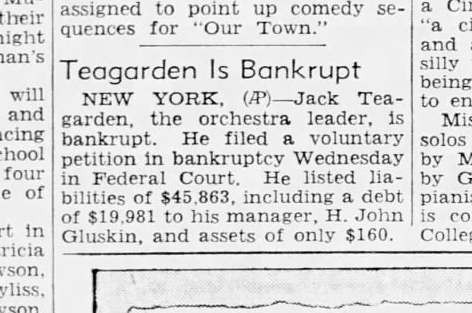
Teagarden turned to Gluskin for help, and according to Smith and Guttridge’s 1960 book “Jack Teagarden: The Story Of a Jazz Maverick” – “Gluskin shrugged and withdrew his interest. On the advice of his attorney, Andrew Weinberger, Jack filed a petition for bankruptcy. The A.F.M. announced that it didn’t recognize bankruptcy.” Weinberger got a temporary injunction to restrain the Union based on the fact the laws of the United States were superior to the regulations of the A.F.M.
The story of Teagarden’s bankruptcy is remarkably similar to the story of Bunny Berigan’s bankruptcy in that most of the same characters were involved: Arthur Michaud, John Gluskin, MCA, and the AFM musicians’ union. The ultimate outcome was much more favorable for Teagarden however, because he employed the services of veteran show-biz lawyer Andrew Weinberger, as Zirpolo notes in his 2013 book “Mr. Trumpet: The Trials, Tribulations, and Triumph of Bunny Berigan” [36]Scarecrow Press – ISBN: 978-0-8108-8153-2.
After a few months a private settlement was reached, the Union, Michaud and his then current manager Gluskin all got a slice of the action. Joe Glaser, Armstrong’s agent signed Teagarden to a seven year contract which saw Jack through to the early 1960’s [37]Armstrong – David Bradbury, Haus Publishing ISBN 1904341470 [38]It is worth noting that Gluskin was an attorney and also business manager to Gene Krupa and others. In August of 1941, Bob Musel wrote a syndicated Associated Press article about the music business … Continue reading
In 1946, Teagarden told a NY Alimony court that he didn’t have the money to pay his former wife, Edna $50 per week [39]Down Beat Dec-16, 1946. Pg5
He formed another band with musicians who were content to accept smaller salary checks and toured back and forth across the nation until 1947. By then the marvelous and unforgettable Big Band Era was dead.
Sometimes truth is stranger than fiction.
The US Copyright cards for the 1948 film “Miracle In Harlem”.
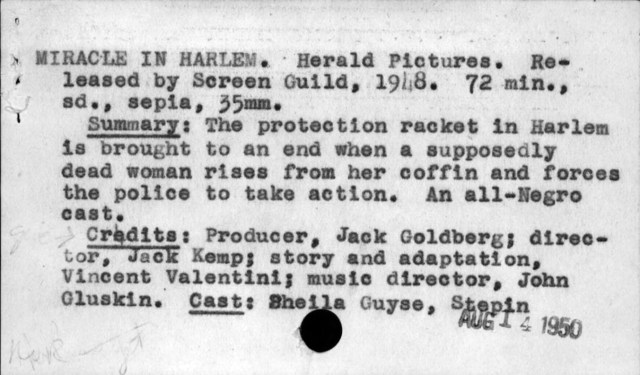

There are almost no coincidences in the music business. H. John Gluskin was a brother of Ludwig (Lud) Gluskin. Lud Gluskin [40]https://www.newspapers.com/article/the-desert-sun-ludwig-lud-gluskin-d/163232552/[41]https://www.findagrave.com/memorial/143792897/ludwig_elias-gluskin was a drummer who had been with the Paul Whiteman band overlapping with Jack Teagarden. Lud’ went on to become Music Director for CBS-TV and retained that position for 10 years. H. John Gluskin and brother Lud’ were involved in a legal action in 1951 for false land sale and mortgage related fees when Lud moved from Spokane to Hollywood. The case dragged on until 1958 [42]https://caselaw.findlaw.com/court/ca-court-of-appeal/1809271.html. According to Down Beat Year Book for 1957, in December 1955 – “Lud Gluskin, an AFM member for 40 years, was expelled from the union for illegally recording cue, bridge, and background music for network TV films.” [43]Down Beat, Year Book, 1957 – Pg 9; Original reporting was included in the Down Beat December 1955 issue on page-6 – Gluskin apparently appealed but his appeal was denied “hindered … Continue reading.
A footnote on the career of Lud Guskin is that he challenged Marius Constant to write “three of four” tunes for $200. One of the tunes recorded three days later became the theme tune for the Twilight Zone [44]Constant in a 1985 interview with High-Fidelity magazine noted that despite Twilight Zone’s success, “that it had been used in several recordings, including one by the well known group … Continue reading
In 1971, the then 67-year-old H. John Gluskin was prosecuted along with three others for conspiring to sell $1.4 million of stock in a company whose over-the-counter trading had been suspended by the Securities and Exchange Commission in 1968 [45]Arizona Republic – Thu, Jan 21, 1971 ·Page 13. In the SEC court case over the illegal sale of the suspended shares of Mastercraft Electronics Corp. the government introduced evidence to show that Harry John Gluskin died age 72, April 18th, 1975 [46]https://archive.org/details/2nd_circ_76_1307_united_states_v_goldenberg. Different times.
Beginning Of The End
Having returned from a tour of England and mainland Europe in October 1958, Jack Teagarden followed this up with an 18 week overseas U.S. State Department tour of the “Near East,” with the tour starting in Afghanistan. The trip covered eighteen countries and 17,000 miles, concluding in January 1959 [47]There is some fascinating film of the tour on youtube, https://www.youtube.com/watch?v=cDQVovXGjHQ / https://www.youtube.com/watch?v=_X2xUPdKqr8.
While the tour was to spread and highlight jazz music and American culture, the tours were also good for sales. Writing in Billboard’s June 29th, 1959, International Scene column, Mildred Hall said, “Wherever jazz recordings are preceded or followed by the live performance of a Gillespie, a Teagarden, a Brubeck, Goodman, or Woody Herman, the response is trebled—also the demand for the records.”
Apart from the tour being exhausting, Jack Teagarden suffered from Uremia[48]Uremia is the condition of having high levels of urea in the blood. Urea is one of the primary components of urine. It can be defined as an excess in the blood of amino acid and protein metabolism … Continue reading towards the end of the tour.
A doctor in Singapore insisted he fly to Manila in the Philippines and have an operation, but Teagarden insisted on continuing the tour without delay, even after the tour organizer for the US State Dept. told him to cancel the tour and return for the operation.
It was though, a news article in a number of syndicated columns, quoted here from the Long Beach, CA Independent – reports that Teagarden was to have surgery for a prostate condition. Teagarden had been admitted on Sunday 25th, January 1959.
In syndicated news, on January 28th, it was reported that Teagarden “was recuperating Wednesday from a double operation at Glendale (CA) Hospital. Surgeons operated to correct a bladder malfunction and a hernia. He will be in the hospital at least 10 days, perhaps longer, doctors said” [49]More than 100 newspapers carried this, usually in the front section of the newspaper. A measure of Teagarden popularity and news worthy-ness. Quote taken from FORT WORTH STAR-TELEGRAM – January … Continue reading

On February 26th, the Los Angeles Evening Citizen News reported Teagarden was being re-admitted following “minor complications” and would be in hospital for a “couple of days”. Down Beat March 5th, 1959 reported only that “Jack Teagarden is recouping from minor surgery he underwent last month.”
As far as I’m aware, Teagarden’s first public appearance post-surgery was on KLTA’s Channel 5 late night show with Larry Finley, which was broadcast nightly from his Sunset Strip supper club above the Mocambo at 8590 Sunset Boulevard. The show went out on March 13th. Next up was on Dave Garroway’s “Today” show on NBC TV, March 26th, 1959. Yes, the same Today show that is still running (https://en.wikipedia.org/wiki/Dave_Garroway). According to the American Federation of Musicians’ April 1959 International Musician magazine, “Jack Teagarden plays the Embers in St. Louis, Mo., for two weeks starting April 13 before switching to Chicago’s Preview Lounge for five weeks beginning May 1st.
Teagarden was slated for a summer of festivals including a repeat of Newport as well Detroit, French Lick, and others. The classic film “Jazz On A Summers Day” filmed at the 1958 Newport Jazz festival in which Teagarden appears was also released in 1959 [50]https://en.wikipedia.org/wiki/Jazz_on_a_Summer%27s_Day. Something Jack and others had to do publicity for.
Repeal Of The Cabaret Tax
Returning to the USA, Jack Teagarden became a leading advocate for the repeal of the World War II federal excise tax, initially 30%, but by 1959, 20%. Teagarden was involved in lobbying and gave a number of interviews about the unfairness of the tax applied to all receipts at any venue that served food or drink and allowed dancing. The tax had been the major reason for the collapse of big bands, as clubs providing only instrumental music were exempt.
Arguably the tax ushered in the Bebop era [51]https://www.aei.org/carpe-diem/how-cabaret-taxes-hobbled-swing-music-cleared-the-dancefloor-and-gave-birth-to-the-bebop-revolution/.
The cut-out mailer seen here was created and printed by Down Beat magazine and included in their August 20th, 1959 issue.
Teagarden and fellow campaigners were heard. The cabaret tax dropped to 10% in 1960 and was finally eliminated in 1965 [52]Felten, Eric (17 March 2013) after Teagarden’s death. “How the Taxman Cleared the Dance Floor”. Wall Street Journal. ISSN 0099-9660.


Fort Worth Star-Telegram
24 Apr 1960, Sun ·Page 39
The Change in Big T
The November 26th, 1959 issue of Down Beat magazine carried a four page article “The Change in Big T: from footloose jazzman to musical statesman” by then Down Beat New York editor, George Hoefer [53]Hoefner died of a heart attack in 1967 while attending a concert at the Ferryboat Restaurant in Brielle, N.J. Hoeffner had been a mentor to Dave Garroway, in his early career at WMAQ Chicago. It is … Continue reading.
Hoeffner’s article is a great summary of many of the issues and highlights of Teagarden’s career and personal life up to this point. Hoeffner noted that during the 1958-59 tour “Jack saw the universal language of music work charms on people who never before had heard any Western music.” After the tour visited Karachi, Pakistan, the city’s chief commissioner wrote to the Pakistani public affairs officer, “My council members and myself self were all charmed by the social manners of the sextet and Mr. and Mrs. Teagarden in particular.”
Hoeffner finished by saying “The new Jack Teagarden, a man socially aware and willing to accept responsibility for more than just good jazz.”
Teagarden’s Final Year – Family Reunion
Jacked Teagarden toured relentlessly, and there is no doubt that the stress and demands of being on the road and playing in clubs contributed to his early demise. One year after recording his final album for Verve, Teagarden and Sextet appeared at Blossom Lane’s “Four Season Lounge” in Benton Harbour, Michigan for a week long residency.
Dixie At The Bowl
On July 26th, at “Dixie At The Bowl,” a sell-out Hollywood Bowl performance, Teagarden, appeared as second fiddle to “Pete Fountain and his Licorice Stick,” who Frank Liberman, reporting for the Los Angeles Evening News, said “Fountain saved the South last night.”
Teagarden was reported by Lieberman as having “a bad case of laryngitis” and “did his best to belt St. James Infirmary Blues, but the strain on his throat was too much.” Fountain was given half the program, and despite appearing again with Bobby Hackett, of whom Lieberman said “the only good thing Hackett had played was a rendition of My Funny Valentine,” asking “how does this fit with Dixie? But since it was nicely done, who cares.”
Sometime between the Benton Harbor appearance and before “Dixie At The Bowl”, Teagarden would record an appearance on a new FM radio show “The Giants Of Jazz”. This was broadcast on July 29 and 30th on different stations but included WFLM-FM Fort Lauderdale. It’s my understanding that this was done in conjunction with the release of an Esquire magazine first edition “World Of Jazz” book [54]Esquire had regularly published jazz related articles and reviews dating from 1934 and the magazine also published Jazz Books in 1944 through 1947. Don DeMichael, who had written the Downbeat review … Continue reading and “World Of Jazz” double album compilation which featured a track from Teagarden [55]https://www.discogs.com/release/6717596-Various-Esquires-World-Of-Jazz.
Monterey Jazz Festival – 163
On September 20th, at the 6th Monterey Jazz Festival, just four months before his death, Jack Teagarden would perform an opening night set with his brother Charlie, Pee-Wee Russell, and Gerry Mulligan as a guest on Friday evening, they were also set to perform Saturday afternoon.
For the Saturday afternoon set, Jack and Charlie brought to the stage their 73-year-old mother, Mrs. Helen Teagarden, to whom Jack paid a loving tribute. Accorded a standing ovation, Mrs. Teagarden performed an encore. Next to the piano came sister Norma Teagarden who had worked with her brothers in their combos and big band.
The festival performance was recorded and released by the Memphis Archives label on CD in 1990 [56]https://www.discogs.com/release/15828600-Jack-Teagarden-A-Hundred-Years-From-Today-Jack-Teagarden-Family-And-Friends.
After the performance, Jack Teagarden was scheduled to appear on a panel, moderated by Downbeat editor Don DeMichael called “What Ever Happened To Dixieland?” along with Pee Wee Russell, Jack’s brother, Charlie Teagarden, Joe Sullivan and Darnell Howard – all Dixieland musicians.
Russ Jones, writing in the Oakland Tribune on September 29th, 1963 noted that “A few days before the festival
Jack, who has recently been in poor health, underwent a physical examination. The doctor warned him he was in imminent danger of a collapse.” – Teagarden, interviewed by Jones seemed to sense his own demise, saying “this might be the last time we’ll all be together”. Teagarden was hospitalized on September 23rd.

Back On The Road
Teagarden was soon back on the road. He was in Kansas City on October 5th for the annual American Royal Coronation Ball;
Later in October the Miami Herald reported he was in town for “business discussions” and a “visit with the family”; In November, Teagarden was at the Metropole Cafe at 7th/48th St. in New York City and so on.
By 1964 Teagarden had established a small roster of reliable multi-week booking locations including the London House in Chicago and The Dream Room in New Orleans. Jack’s struggles with alcohol and personal issues had resulted in a significant decline in his health. He was dealing with obesity and faced persistent episodes of flu and pneumonia. His condition was grave, leaving him in a state of continual exhaustion.

He had received an advance for a series of performances at the Dream Room in New Orleans, he defied his doctor’s recommendations and traveled regardless of his worsening health.
Connie Jones is renowned as one of the most talented jazz trumpeters to emerge from New Orleans [57]https://en.wikipedia.org/wiki/Connie_Jones. Jones had a distinguished career and led his own band. He was playing with Teagarden at the time of Jack’s death. He spoke to Vernon Films about Jack’s last days:
Jack told us that we were going to New Orleans to play. I believe it was a three or four week engagement in New Orleans at the Dream Room. It didn’t go well at all for Jack.
He was feeling pretty weak. I don’t recall if he had a bad cold or a head flu or what but his voice was giving up on him. They decided to put him in the hospital.
It’s kind of like an outpatient type of thing that he would go out for maybe five hours a day and a job and the rest of time he spent in the hospital. The last few nights that we did work, Jack’s energy level was so low that he played the entire night sitting on a chair on the stage.
Jack was pretty much running out of gas at the end and I had called Abby [Jack’s wife] and asked her to come down and help get Jack back on his feet. They had a terrific blizzard in New York and nothing was moving. She was just snowed in New York and could not get out and when she did get back it was just too late and they gave a little teaser for the news. New Orleans jazz man found dead in New Orleans Hotel and it turned out to be Jack.
1996 Vernon Films documentary about Jack “It’s Time For T” produced by Stephen Charles LeVere, Joe Showler and Robert Gibbons.
There are numerous biographical records of Teagarden. Perhaps it’s his tragic passing that makes him one of the most cherished and celebrated white jazz musicians, resonating deeply with those who admire his legacy. As a mark of his importance, his death and funeral resulted in more than 2,000 newspaper reports.
The Los Angeles Times ran the news of Teagarden’s passing on the front page. Jack and his family had lived in Hollywood, his mother in Long Beach, CA for many years before moving to Pompano Beach, Florida. The Times described Teagarden’s death more graphically.
Teagarden was found dead Wednesday in a motel room within earshot of the Dream Room, a nightclub in the colorful French quarter of New Orleans.
Teagarden played his last engagement at the Dream Room, on the Bourbon St. his music had helped to make famous. At 1 a.m. on the day he died Teagarden said he was too tired to play anymore.
He was found face down on the floor of the motel room. A can of beer was underneath him, and an opener was in his hand. He was 58.
Los Angeles Times – FRIDAY MORNING, JANUARY 17, 1964.
The LA Times dedicated 2-pages to Teagarden’s passing. It is quite a read. A PDF version of the pages can be read here [58]http://ctproduced.com/wp-content/uploads/2024/01/Los-Angeles-Time-Jan-17-1964-Jack-Teagarden.pdf The cause of death was generally reported to have been a heart attack. According to UPI reporting at the time, a doctor said Teagarden had died of cirrhosis of the liver.
His records had sold in the millions, but he was simply just another act on a huge roster by then and never made the money an entertainer and musician of his stature should have. It’s worth noting that many of his albums were rereleased posthumously, as well as some of his most popular recordings which had not been released as albums but as 78s.
Finally, Teagarden’s long friendship with Louis “Satchmo” Armstrong ended with his death, just a few years later Satchmo would record the evocative and very much out of character track “We Have All The Time In The World” as the theme tune for the 1969 James Bond film, “On Her Majesty’s Secret Service”. Armstrong passed two years later. The record was produced by Phil Ramone, who spent much of his early career working with Creed Taylor.
Like many of the songs on Teagarden’s Taylor produced albums “Mis’ry And The Blues” and “Think Of Me Well”, Armstrong’s “We Have All the Time in the World” is a soulful and timeless song performed by a legend. Like Teagarden’s track, especially “Where Are You” and “Basin Street Blues”, Armstrong combines warmth, heartfelt delivery and well as a hint of melancholy, encapsulating a essence of love and serenity.
For me, those two Teagarden albums, are masterfully captured and hold appeal and evoke a sense of comfort and tranquility, his lazy laconic drawl evokes, for me, a laid-back charm that matched perfectly with his trombone playing.
More Information
Museums
The plans to open a Teagarden Museum in Vernon, Texas, have stalled. A 2017 report in the Fort Worth Star-Telegram described how Mark Farr-Nash has been working to raise money and refurbish a building in the town as a museum for Teagarden. There is a website for the museum, but it also seems to have stalled and fallen into disrepair. [59]https://web.archive.org/web/20230925122629/http://www.teagardenmuseum.org/about/.
According to an archive of the museum website, it appears that the museum acquired the late Joe Showler Teagarden collection [60]https://www.proquest.com/openview/8001fdbb749cbd4ade306d88b76073ea/1?cbl=25292&pq-origsite=gscholar. It is perhaps one of the most complete collections of any artist. Showler, a Canadian, died in February 2009 [61]https://www.findagrave.com/memorial/138581021/john-cameron-showler. There is an interview with Showler from 1976 on YouTube [62]https://www.youtube.com/watch?v=8kqaNJFgp9o.
Joe Showler is also featured in a segment on vinyl record collecting in Alan Zweig’s “Vinyl,” a somewhat bizarre, full-length feature film that includes an open and vulnerable look at the obsession and compulsion some record collectors experience. [63]This link jumps 1 hour 5 minutes into the video. If you ever feel you have too many records, you should watch the whole film. https://youtu.be/nkCMSrvOTAo?si=60zPBC5EghtGpvHf&t=3945.
Showler’s collection encompasses various forms of media that chronicle the life and work of Jack Teagarden, including:
- 1000 78RPM records, highlighting rare and scarce pressings.
- A vast archive of over 5000 photographs, documenting Jack’s life from infancy to his later years.
- An extensive film library of over 500 hours, featuring both commercial films and personal home movies.
- Over 50 hours of interviews with surviving band members and their wives, providing personal insights.
- A significant musical collection of over 1000 albums of studio and live performance recordings, which also features rare pressings.
- An audio trove of over 500 hours of reel-to-reel tape, containing private recordings and unpublished material.
- A library of over 400 books dedicated to the history of Jazz and motion pictures.
I’ve reached out to an email address for the Museum and will update this if I receive a response [64]https://finnswake.livejournal.com/43340.html#cutid1. If Anyone reads this and has any information, please use the contact form.
The collection had previously been valued at more than $300,000.
Red River Valley Museum
Red River Valley Museum, also in Vernon, TX does have a small exhibition of Teagarden history. I was informed that the Teagarden museum had indeed not opened, but the contact I spoke believed the building was still owned by the same people.
Media
Teagarden has one of the largest discographies of any Jazz artist, the Internet Archive has more than 1,000 tracks by Jack Teagarden in different configurations. A large number of the tracks are out of copyright and were issued on 78RPM records. Many can be downloaded [65]https://archive.org/details/audio?query=Jack+Teagarden.
As with film, Jack Teagarden features in many books. There are two books that cover his life and recordings, both first published in 1960. The Waters book has been impossible for me to locate, while the Smith/Guttridge book is available widely, including through the library.
- “Jack Teagarden’s Music: His Career and Recordings” by Howard J. Waters Jr., Published Walter C. Allen; First Edition (January 1, 1960).
- “Jack Teagarden: The Story of a Jazz Maverick” by Jay Smith, Le Guttridge” – originally published in 1960 by Cassell, ISBN-13: ISBN-13: 9780306803222 [66]https://www.google.com/books/edition/Jack_Teagarden/Rf8HAQAAMAAJ?kptab=overview.
Obviously, since they were published in 1960, they have no detail or information of the later Taylor recordings.
Teagarden In Film


Jack Teagarden would appear at many of the early Newport Festivals, then known as the “American Jazz Festival” and held in Newport Rhode Island. Jack appears in the 1958 Newport Festival classic film by Bert Stern “Jazz On A Summers Day” [67]https://en.wikipedia.org/wiki/Jazz_on_a_Summer%27s_Day. Stern film, and the concert recording from that year are probably the jazz film and audio recording with the greatest ever number of releases, in the most countries [68]https://www.discogs.com/sell/release/11139360[69]https://www.discogs.com/search/?q=%22jazz+on+a+summers+day%22&type=release#more_facets_format_exact. Primarily, Teagarden is seen singing and playing with Armstrong on a duet of “Rockin’ Chair”, a duet that had become a “raison d’être” for the two senior gentlemen of jazz.
Teagarden is also variously in the following jazz music films that provide important historical perspective.
- “The Big Broadcast of 1936” (1936) – Teagarden appeared as himself in this musical comedy film, which also starred Bing Crosby and George Burns.
- “Syncopation” (1942) – Teagarden appeared as himself in this drama film about the rise of jazz music.
- “The Fabulous Dorseys” (1947) – Teagarden played himself in this biographical film about Tommy and Jimmy Dorsey, two famous jazz musicians.
- “The Strip” (1951) – Billed as a crime noir film, starring Mickey Rooney, the film was largely shot around Sunset Strip. The Mocambo club is featured in the film, which is the same location Teagarden visited for the KLTA’s Channel 5 late-night show with Larry Finley in 1959. Teagarden appears briefly in the film’s trailer. [70]https://www.youtube.com/watch?v=yL–UAC84lI
- “The Benny Goodman Story” (1956) – Teagarden played himself in this biographical film about Benny Goodman, the famous clarinetist and bandleader.
It’s worth noting that these films are not entirely dedicated to Jack Teagarden, but he appeared in them as himself, playing his instrument and singing.
It was reported in the July 23rd, 1957 issue of Down Beat that “the success of Red Nichol’s life story, “The Five Pennies,” has inspired Paramount to buy the rights a Jack Teagarden life story.” This was never made, however included below is the 1996 Vernon Films documentary about Jack “It’s Time For T” produced by Stephen Charles LeVere, Joe Showler and Robert Gibbons. If my summary of Jack’s recordings with Creed was interesting, this fills-in pretty much everything else.
Teagarden was a regular on TV and in film. The IMDB listings are pretty comprehensive [71]https://www.imdb.com/name/nm0853524/?ref_=fn_al_nm_1.
References
| ↑1 | Nat Hentoff, International Musician magazine – May 1961 |
|---|---|
| ↑2 | https://www.jazzwax.com/2008/05/interview-cre-3.html |
| ↑3 | https://en.wikipedia.org/wiki/(Is_This_the_Way_to)_Amarillo |
| ↑4 | I have an articles on both Joe Glaser and Clarence Avant in draft form and hope to publish them both in 2025. |
| ↑5 | https://en.wikipedia.org/wiki/Joe_Glaser |
| ↑6 | Jazz Magazine – January 1965 Vol 4 No 1, Pg21 |
| ↑7 | Cover notes, BCP 6040 Bethlehem – Jack Teagarden – “Meet Me Where They Play The Blues” |
| ↑8 | Down Beat – November 14th, 1956 Pg46 |
| ↑9 | HIFI/STEREO February 1962, Pg90 |
| ↑10 | Classic jazz : a personal view of the music and the musicians – University of California Press, ISBN 0-520-21360-2 |
| ↑11 | https://www.discogs.com/release/2025321-Eddie-Condon-Max-Kaminsky-Chicago-And-All-That-Jazz |
| ↑12 | TV Scout column, Philadelphia Daily News – Fri, Dec 8, 1961, Pg67 |
| ↑13 | Verve Rushes LP On Jazz TV’er” – Cash Box magazine – November 25th, 1961 and December 16th, 1961 |
| ↑14 | As of writing there was one copy, still sealed for sale on ebay. |
| ↑15 | https://www.youtube.com/watch?v=9szX2cQyej4 |
| ↑16 | Franz Hoffman who has compiled two comprehensive volumes, one “Jazz On Film And TV” and the second on “Jazz Advertised” includes the following in his latest “Jazz On Film” wrote the following. “The widely reviewed NBC TV show of November 1961, Chicago and All That Jazz. I researched this show for my Red Allen project, exchanging letters with Cozy Cole, who had coached Mae Barnes on drums for her part in the show. When a 35mm reel copy turned up, comparison showed that all circulating versions, including the commercial video, had come from the same source. According to a rumor that I heard, the copyright holders and associate producer Norman Kahn had ordered all reels to be destroyed and a housekeeper saved one copy, not for commercial purposes but for jazz history’s sake.” |
| ↑17 | http://ctproduced.com/otd-conversations-with-myself/ |
| ↑18 | John Wilson review – Down Beat – February 15th, 1962, Pg34. |
| ↑19 | https://www.discogs.com/artist/313010-George-Wettling |
| ↑20 | https://en.wikipedia.org/wiki/Burt_Goldblatt |
| ↑21 | Down Beat, February 14th, 1963 Pg37 |
| ↑22 | https://www.discogs.com/master/2434777-Jack-Teagarden-Jack-Teagarden |
| ↑23 | https://www.discogs.com/release/21671488-Jack-Teagarden-Jack-Teagarden |
| ↑24 | https://www.discogs.com/artist/647196-The-Creed-Taylor-Orchestra |
| ↑25 | Downbeat – October 25th, 1962 |
| ↑26 | The Miami Herald Fri, Nov 24, 1995 |
| ↑27 | https://www.jazzwax.com/2022/08/the-mysterious-life-of-don-goldie.html |
| ↑28 | Gene Lees Jazz Letter, June 1984- VOL. 3 NO. ll |
| ↑29 | https://revivethis.org/the-david-w-niven-collection/ |
| ↑30 | https://archive.org/details/davidwnivenjazz&tab=collection |
| ↑31 | Satchmo: My Life in New Orleans -A Da Capo paperback, 1986 ISBN 0-306-80276-7 |
| ↑32 | Down Beat, September 1939, P32 |
| ↑33 | The Afro-American, Sat, Mar 06, 1948 · Page 6 – Baltimore, Maryland |
| ↑34 | https://www.michaelcorcoran.net/jack-teagarden/ |
| ↑35, ↑37 | Armstrong – David Bradbury, Haus Publishing ISBN 1904341470 |
| ↑36 | Scarecrow Press – ISBN: 978-0-8108-8153-2 |
| ↑38 | It is worth noting that Gluskin was an attorney and also business manager to Gene Krupa and others. In August of 1941, Bob Musel wrote a syndicated Associated Press article about the music business being taken over by attorneys since it had become “a multi-million dollar industry”. Both Gluskin and Weinberger were featured. |
| ↑39 | Down Beat Dec-16, 1946. Pg5 |
| ↑40 | https://www.newspapers.com/article/the-desert-sun-ludwig-lud-gluskin-d/163232552/ |
| ↑41 | https://www.findagrave.com/memorial/143792897/ludwig_elias-gluskin |
| ↑42 | https://caselaw.findlaw.com/court/ca-court-of-appeal/1809271.html |
| ↑43 | Down Beat, Year Book, 1957 – Pg 9; Original reporting was included in the Down Beat December 1955 issue on page-6 – Gluskin apparently appealed but his appeal was denied “hindered general protection and and advancement of the interests of musicians and acted in bad faith and engaged in unfair dealings.” The appeal is also covered in the International Musician magazine, June 1956 |
| ↑44 | Constant in a 1985 interview with High-Fidelity magazine noted that despite Twilight Zone’s success, “that it had been used in several recordings, including one by the well known group Manhattan Transfer that became a best-selling album; that there were several popular books about the television series; that Steven Spielberg made a film that used the theme; that there were toys that played the melody (I found one marked “Made in Hong Kong”). Since I had never received any credit, I thereby had become the most anonymously celebrated person in the United States!” High-Fidelity Magazine – April 1985, pg64. |
| ↑45 | Arizona Republic – Thu, Jan 21, 1971 ·Page 13 |
| ↑46 | https://archive.org/details/2nd_circ_76_1307_united_states_v_goldenberg |
| ↑47 | There is some fascinating film of the tour on youtube, https://www.youtube.com/watch?v=cDQVovXGjHQ / https://www.youtube.com/watch?v=_X2xUPdKqr8 |
| ↑48 | Uremia is the condition of having high levels of urea in the blood. Urea is one of the primary components of urine. It can be defined as an excess in the blood of amino acid and protein metabolism end products, such as urea and creatinine, which would normally be excreted in the urine. Uremic syndrome can be defined as the terminal clinical manifestation of kidney failure |
| ↑49 | More than 100 newspapers carried this, usually in the front section of the newspaper. A measure of Teagarden popularity and news worthy-ness. Quote taken from FORT WORTH STAR-TELEGRAM – January 28th, 1959 P4 |
| ↑50, ↑67 | https://en.wikipedia.org/wiki/Jazz_on_a_Summer%27s_Day |
| ↑51 | https://www.aei.org/carpe-diem/how-cabaret-taxes-hobbled-swing-music-cleared-the-dancefloor-and-gave-birth-to-the-bebop-revolution/ |
| ↑52 | Felten, Eric (17 March 2013) after Teagarden’s death. “How the Taxman Cleared the Dance Floor”. Wall Street Journal. ISSN 0099-9660. |
| ↑53 | Hoefner died of a heart attack in 1967 while attending a concert at the Ferryboat Restaurant in Brielle, N.J. Hoeffner had been a mentor to Dave Garroway, in his early career at WMAQ Chicago. It is no coincidence then, that Teagarden would appear on Garroway’s Today show. Hoeffner had a fabled collection of some 7,500 shellac jazz disks that he had been collecting since 13-years old. |
| ↑54 | Esquire had regularly published jazz related articles and reviews dating from 1934 and the magazine also published Jazz Books in 1944 through 1947. Don DeMichael, who had written the Downbeat review of Mis’ry And The Blues, discussed above, in his review of this book, was scathing about everything except the artwork. |
| ↑55 | https://www.discogs.com/release/6717596-Various-Esquires-World-Of-Jazz |
| ↑56 | https://www.discogs.com/release/15828600-Jack-Teagarden-A-Hundred-Years-From-Today-Jack-Teagarden-Family-And-Friends |
| ↑57 | https://en.wikipedia.org/wiki/Connie_Jones |
| ↑58 | http://ctproduced.com/wp-content/uploads/2024/01/Los-Angeles-Time-Jan-17-1964-Jack-Teagarden.pdf |
| ↑59 | https://web.archive.org/web/20230925122629/http://www.teagardenmuseum.org/about/ |
| ↑60 | https://www.proquest.com/openview/8001fdbb749cbd4ade306d88b76073ea/1?cbl=25292&pq-origsite=gscholar |
| ↑61 | https://www.findagrave.com/memorial/138581021/john-cameron-showler |
| ↑62 | https://www.youtube.com/watch?v=8kqaNJFgp9o |
| ↑63 | This link jumps 1 hour 5 minutes into the video. If you ever feel you have too many records, you should watch the whole film. https://youtu.be/nkCMSrvOTAo?si=60zPBC5EghtGpvHf&t=3945 |
| ↑64 | https://finnswake.livejournal.com/43340.html#cutid1 |
| ↑65 | https://archive.org/details/audio?query=Jack+Teagarden |
| ↑66 | https://www.google.com/books/edition/Jack_Teagarden/Rf8HAQAAMAAJ?kptab=overview |
| ↑68 | https://www.discogs.com/sell/release/11139360 |
| ↑69 | https://www.discogs.com/search/?q=%22jazz+on+a+summers+day%22&type=release#more_facets_format_exact |
| ↑70 | https://www.youtube.com/watch?v=yL–UAC84lI |
| ↑71 | https://www.imdb.com/name/nm0853524/?ref_=fn_al_nm_1 |
UPDATES:
4/4/2026: Updated TOC
Discover more from Creed Taylor Produced
Subscribe to get the latest posts sent to your email.
Amazing reporting! Thank you. This is such an important piece of jazz history, so well researched. Those all-too-little-known Verve records you chronicle – and the ones that come before – are wonderful and so well worth hearing and knowing. Really appreciate the deep dive here.
Well done, thanks! Take care, Doug