
(This post was originally scheduled for 9/22/2025 – suffice to say I was sucked into a whole nostalgia time warp around the Half Note. See the final sections for details and pictures.)
Success would come to Wes Montgomery in different ways after he signed for Verve and with Creed Taylor. September 22nd, 1965, was the recording of perhaps one of jazz’s most famous live recordings, Wes Montgomery and Wynton Kelly’s “Smokin’ At The Half Note.” Except it wasn’t; the live tracks were recorded in June of that year.
This post walks through the period before and after the release of the album. It includes two groups of live sets: the first from Wes Montgomery’s European tour before recording, and the second in 1966. These sets can be streamed or downloaded.
In an interview, Pat Metheny called Smokin’ at the Half Note “the absolute greatest jazz-guitar album ever made. It is also the record that taught me how to play.” [1]This quote is often attributed to a 2005 New York Times article; in fact, it appeared much earlier in the Detroit Free Press, Mon, Aug 10, 1987 issue on Pg 39 – … Continue reading. Metheny also references the importance of Montgomery and this performance in a DVD and accompanying booklet produced in 2007 [2]Wes Montgomery: Live in ’65 / Reelin’ in the Years Productions; producers, David Peck, Philip Galloway, and Tom Gulotta..
Just the other day, I was watching a video about CTI on youtube, when a reviewer also described the album as “possibly the best live jazz recording ever.”
Most of the guitar on this set wasn’t generated in the club at all but in Rudy Van Gelder’s studio, a far friendlier space than the nightclub’s boxy, unkind acoustics. Even so, Montgomery slides in and delivers some of his best playing. — I especially like “Four on Six,” which still dazzles, and on “Unit 7,” Wes remains untouchable.
Only The Good Die Young
Montgomery’s guitar style was often understated, always clear, and never loud. On some tracks, it could almost be melancholy. In some ways, it is the perfect soundtrack for three of four men who would all die young.
Montgomery’s passing just three years after the Half Note dates, in 1968 age just 45, is well known [3]https://en.wikipedia.org/wiki/Wes_Montgomery; less so, Kelly also died young, in fact, much younger. Kelly died in Toronto, Canada, on April 12, 1971 – following an epileptic seizure, with which Kelly had a long history of suffering. He was just 39 [4]https://en.wikipedia.org/wiki/Wynton_Kelly.
Sadly, Paul Chambers the bass player died in 1969, aged 33 from the results of tuberculosis, likely worsened by his addiction to alcohol and drugs [5]https://en.wikipedia.org/wiki/Paul_Chambers. Cobb lived and played on until 2020, age 91 [6]https://en.wikipedia.org/wiki/Jimmy_Cobb although at the time of his death, he had been suffering from lung cancer.
The Recording
There wasn’t one “night at the Half Note”, there were also many other appearances which make it difficult to date all the live tracks. Tracks have subsequently appeared on Smokin’ and other albums, and various releases and reissues. The Wes Montgomery and Wynton Kelly Trio performed for six nights from June 22 to 27 at the Half Note and went on to the Newport Jazz Festival, where they played Sunday afternoon (July 4th) 1965.
Montgomery and the Wynton Kelly Trio were billed for the Showboat Jazz Theater in Philadelphia from June 21 to 26 [7]Down Beat – June 17, 1965, Pg46. It’s not clear if they appeared at both venues while driving between the Showboat and the Half Note. We know that at least Wes wouldn’t have flown. Montgomery had been a leading contender to join the Oscar Peterson Trio but wouldn’t commit because of the flight requirement.

The Philadelphia Daily News includes an advert for the Showboat, which includes Red Garland and his Trio and the Jimmy McGriff Organ 4 covering the same dates [8]Philadelphia Daily News – Mon, Jun 21, 1965 ·Pg33. Effectively confirming Montgomery and the Kelly Trio didn’t appear at both clubs.
| Year | Title, label, Country |
|---|---|
| 1965 | Original Album contains only 2x live tracks, “No Blues” and “If You Could See Me Now” – recorded on June 24th at the Half Note. |
| 1968 | Willow Weep For Me, Verve, US – 7x tracks recorded at Half Note, 1965 – also subsequently released on vinyl and CD in many countries [9]https://www.discogs.com/master/82211-Wes-Montgomery-Willow-Weep-For-Me. Produced by Esmond Edwards, not Creed Taylor. 3x tracks feature Ogerman arranged woodwind and brass overdubs. |
| 1976 | The Small Group Recordings – 2 x Vinyl, LP, Compilation includes 9x live tracks inc. some from May/June 1965; 2x tracks with Jimmy Smith produced by Esmond Edwards – some are issued in non-gatefold sleeves [10]https://www.discogs.com/master/306725-Wes-Montgomery-The-Small-Group-Recordings . |
| 1990 | Smokin’ At The Half Note, Verve, Spain – CD includes tracks from 1968 Willow Weep For Me [11]https://www.discogs.com/release/10291203-Wynton-Kelly-Trio-Wes-Montgomery-Smokin-At-The-Half-Note |
| 2005 | Smokin’ At The Half Note, Verve, USA – same tracks as 1990 Spanish reissue incorporating Willow Weep For Me- same issued in other countries [12]https://www.discogs.com/release/27997104-Wynton-Kelly-Trio-Wes-Montgomery-Smokin-At-The-Half-Note |
| 2007 | There are two DVD’s released in 2006 and 2007 that include film from the European tour and contain many of the tracks that are also available as audio releases. While the Belgium concert is found on both releases, the London tracks are from the two different appearances. Montgomery Live In 65 is more easily available as it was issued in the USA & Canada [13]https://www.discogs.com/release/3026690-Wes-Montgomery-Live-In-65 while In Europe 1965 released in 2006 contains four fewer tracks and was only released in Europe [14]https://www.discogs.com/release/9407924-Wes-Montgomery-In-Europe-1965 |
| 2011 | The Complete Verve Sessions (5x CD) Hip-O Select – includes both the live and live(overdubbed) versions of “Willow Weep For Me” as well as other tracks. |
| 2013 | The Unissued 1965 Half Note Broadcasts – CD release by European Jazz on Jazz label. Two broadcasts from the Half Note of the “Portraits in Jazz” show claimed not to have been released before. Dates are subject to confusion, claim to be Feb 12th and 19th but doubts are cast on this in the liner notes. [15]https://www.discogs.com/release/10420663-Wes-Montgomery-The-Wynton-Kelly-Trio-The-Unissued-1965-Half-Note-Broadcasts |
| 2013 | Smokin’ At The Half Note, Analogue Productions – Original 5-tracks on 2 x Vinyl, 12″, 33 ⅓ RPM, Album, Remastered, Stereo, 200g [16]https://www.discogs.com/release/4793503-Wynton-Kelly-Trio-Wes-Montgomery-Smokin-At-The-Half-Note. Also reissued on CD in 2023. |
| 2017 | Smokin’ In Seattle / Live At The Penthouse Previously unreleased live sets featuring Wes Montgomery with Wynton Kelly’s Trio inc. bassist Ron McClure – Recorded at Seattle’s Jazz Club, the Penthouse, on April 14 and 21, 1966 and broadcast on KING-FM [17]https://resonancerecords.org/product/wes-montgomery-with-the-wynton-kelly-trio-smokin%c2%92-in-seattle-live-at-the-penthouse-1966-cd/ also available in a 2025 reissue [18]https://www.discogs.com/sell/release/33678129. |
| 2023 | Maximum Swing: The Unissued 1965 Half Note Recordings – issued in the USA & Japan by Resonant Records as a Record Store first release 3xLP release; also issued in the US as a 2x CD set which comes with a 52-page booklet. Does NOT include the original tracks. Probably the definitive release of additional live tracks. [19]https://resonancerecords.org/shop/ – I do not have this set and contacted Resonance to check if they are still selling it, they have not replied. |

In 1993, Creed Taylor worked with German distributor ZYX to issue a CD version of the original Smokin’ album on CTI as PDCTI 1117-2 – This was limited to the tracks on the original mix-down master tape and only distributed in Germany where they had the rights [20]https://www.dougpayne.com/cti_pd.htm [21]https://www.discogs.com/release/3492437-Wynton-Kelly-Trio-Wes-Montgomery-Smokin-At-The-Half-Note. The release carries Taylor’s signature but otherwise, like the other PDCTI releases from that period does not carry any new liner notes and in fact is really quite unremarkable.
King Japan continues to issue only the original album tracks, even on remastered CD, SHCD etc. This is likely because they have original mixdown tapes and not the studio masters, it may also be related to licensing for reissue.
I’m sure there are many other variants from these recordings, I’ve done my best to include the most important and those that are reasonably available.
About The Orchestration
It is very unlikely that Wes Montgomery would have reached the levels of financial success he did, had Creed Taylor not added strings and arrangements to his guitar virtuoso. With that came plenty of criticism both from musicians and of course the jazz police. It was something that dogged Creed’s productions of major artists.
My favorite example is from the same year, 1965. Jazz guitarist Howard Roberts faced Leonard Feather’s Blindfold Test in the July issue of Downbeat. In the final track, track-8, Feather played Montgomery’s “Movin’ Wes” from the 1965 Verve-released album of the same name, produced by Creed Taylor and arranged by Johnny Pate. In Response, Roberts said “the dynamic mass of the band seemed to be pressuring Wes to stick to octaves throughout, to be heard. I think he felt like a sneeze in a hailstorm there.” [22]Downbeat July 1965, Pg 48
The sleeve notes for Willow Weep For Me album, Richard Lamb notes “Now, about the horns. No, they were not hidden there at the Half Note, squeezed in between the washroom and the weed machine. They were added later, and Wes fans will welcome the additions.” – in this case the arrangements, orchestration and conductor was Claus Ogerman. Brian Priestley called the Ogerman process “bastardization” when reviewing the album [23]Jazz Journal June 1969, Pg29 .
In this case, although not produced by Creed Taylor, but rather Esmond Edwards.
Courtesy of the Complete Verve (5x CD) box set, you can hear the same version of Willow Weep For Me both with and without the Ogerman overdubs. I listened to them time and time again while writing this, and while it’s true there is something more subtle about Montgomerys guitar on the undubbed recording, the addition of 4-5 brass, 2 reeds does make the track more complete [24]it is “unknown” who the musicians were that played on the overdub session with Ogerman. If money and time were no object I’d go visit the AFM archives to see if I could make a match..
It’s a subject of some debate if they recorded the strings and rhythm sections first and had Montgomery play over them, or if Montgomery would play in a small group format and the arranger (Pate/Sebesky/Ogerman/Nelson) would overdub afterwards. There seems to be evidence to support both. In his review of the Complete Verve Recordings Verve/Hip-O Select, Shaun Brady says that “Sebesky had Montgomery record with a rhythm section and then added strings after the fact.” [25]Downbeat Jan. 2012 Pg99
Reception
The Smokin’ album was released in December 1965.
Review in Cash Box December 18th, 1965 Pg 24.
The Wynton Kelly Trio, with the leader on piano, Paul Chambers on bass and Jimmy Cobb on drums, along with outstanding jazz guitarist Wes Montgomery cut a wild scene at N.Y.’s Half Note Club and the sound is captured on these 5 tracks. The boys have a sound that swings like there is no tomorrow, but at the same time remains far enough in, so as not to loose the middle-of-the-road jazz buff.
Give a special listen to the lead track, “No Blues,” a Miles Davis tune that the foursome does up to perfection.


Tampa Tribune – December 26th, 1965 Pg29.
The Tampa Tribune included a review of the album in the Vance Johnston column. Vance noted “Some of the best jazz in America is to be found on Verve” and its current releases contain a number of fine albums.
The Wynton Kelly Trio with Wes Montgomery on guitar offer, “Smokin’ At The Half Note” and jazz buffs not only from the performers work but the tunes they play should go for this one.
This “live” performance captures the mood and spirit of those listening and is happily reflected and transmitted on to those who hear this great session. “What’s New” is given a new dimension and the work of Kelly and Montgomery is fantastic. Five tunes in all.
Down Beat, Jan. 27th, 1966 Pg32 – John S Wilson
The addition of Montgomery to the Kelly trio has provided the guitarist with a strong and supple setting for his consistently enlivening work, and it has given the Kelly trio a kind of distinction it never achieved on its own.
Montgomery romps through this set, filling his solos with a fascinating variety of attacks and ideas. Kelly works with him excellently as an accompanist, but the pianist is in a distinctly subordinate role. His solos are in the blandly bouncing but relatively anonymous style in which he
seems to play everything. Kelly does his best solo work on New, during which he digs in under the superficial level on which he works through most of the disc.
But Montgomery never lets down. He is, fortunately, out front most of the time, building solos in a seemingly casual fashion, yet developing and broadening them with every passing chorus. This is his record completely [26]It is worth noting that the March 10th issue of Down Beat – Reader Paul F. Macri pf Watkins Glen, NY – took reviewer Wilson to task over his treatment of Wynton Kelly noting among other … Continue reading

Taylor though was already planning the next album, and in January the industry magazines were talking about Montgomery’s Goin’ Out Of My Head – with Taylor quoted as saying “It will be one of our biggest Albums of 1966.” The only Montgomery chart action that month was Melba Montgomery (no relation) who was in the country charts with Gene Pitney and Baby Ain’t That Fine [27]https://www.discogs.com/master/990121-Gene-Pitney-And-Melba-Montgomery-Baby-Aint-That-Fine.
In February, BUMPIN’ – Wes Montgomery was nominated for Grammys in the “Best Instrumental Jazz Performance” and “Best Original Jazz Composition” categories. The same week Bumpin’ was dropping out of the charts and there was no sign of Smokin’ At The Half Note.
Come March 1966, Goin’ Out Of My Head had been released and entered the R&B and Jazz charts, a back in business Riverside had released Portrait Of Wes – which was a “special merit pick” in Billboard and at least the industry had moved on.
FUN FACT: Creed Taylor told Marc Myers, JazzWax that he had taken a copy of Little Anthony & The Imperials 45RPM Going Out Of My Head to the Half Note for Wes Montgomery. Wes listened to it and said, “Creed, you must be going out of your head. I can’t do that kind of stuff [28]https://web.archive.org/web/20220824135526/https://www.jazzwax.com/2022/08/creed-taylor-1929-2022.html.
Montgomery Live in ’65
Montgomery recorded his first sessions in 1948 with Lionel Hampton; by 1955 recorded as the Wes Montgomery / The Montgomery Brothers Quintet for Columbia and Resonance; his first Riverside studio dates were in 1959; and in 1961 the first Verve album as the Montgomery Brothers and in 1964 under his own name. It was in 1961 that Montgomery first recorded with Wynton Kelly at Plaza Sound Studios in New York.
Cobb would tell Rick Mattingley “He [Wes Montgomery] was doing some single stuff, and wanted to work with our rhythm section. He used to listen to us play all the time before he left Indianapolis.” “he liked our thing and used us on some tours and records.” [29]Modern Drummer August/September 1979 Pg30.
It was during a west coast tour with Miles Davis that the trio would first record live with Montgomery during a break in Davis schedlue on June 25th, 1962 at the Tsubo Cafe in Berkley. The album was first released on Riverside as Full House later in 1962; additional tracks were release in 1982 on Milestone as The Alternative Wes Montgomery; and in 2023 in a Craft Recordings release as The Complete Full House Recordings(3x LP) [30]https://www.discogs.com/release/28975270-Wes-Montgomery-The-Complete-Full-House-Recordings.

The Tsubo and Half Note Cafe sessions give a great opportunity to enjoy and compare the styles as they played in a less structured non-studio environment. Given the Half Note sessions were over multiple days and the Tsubo sessions were a set of managed takes and retakes, it’s important not to listen to them as a representative, freeform live set.
Early on in 1965, Wes Montgomery would spend time on the west coast and touring in Canada. “The Town” in Toronto was running “Coming Soon” listings for Montgomery from late January.
They were in Montreal from Feb. 15th at club “Le Jazz Hot” at 94 St Catherine E. as listed in the Montreal Gazette and then in Toronto for a week from March 3rd at “The Town” at 16 Queen St E. – interesting to note that The Town management and promoter listed Stanley Turrentine and Shirley Scott as “The trio of the year” in their advert in the Toronto Star newspaper.


European Tour
On some of the releases that feature tracks from the Half Note sessions, you can hear Alan Grant say that Wes had been in Europe. Indeed, he had, and thanks to Kim Paris and the Internet Archive’s “FM Radio Archive,” you can listen to these tracks and download them.
Wes performed at the annual San Remo Jazz Festival in Italy on March 20-21st and in London with a recording of the BBC TV JAZZ625 show on March 25th [31]https://youtu.be/L8V0eYLBiJ0?si=-mPSXXKx0G7Y5DDu.
The three sets here include: two tracks from an ORTF broadcast on March 27th, Champs-Élysées, France; four tracks from VPRO Studio, Hilversum, Holland, on April 2nd; five tracks from the April 4th BRT broadcast, Brussels, Belgium [32]The tracks in each set can be displayed by expanding the playlist, which also shows a download link for each set. [33]The full FM Radio Archive entry for these recordings is https://archive.org/details/wes-montgomery-live-in-europe-spring-1965.
Three European live albums, including “Live In Paris” were produced from Montgomery’s Paris performances. His sidemen for the European tour were Harold Mabern – piano, Jimmy Lovelace – drums. An album “Body And Soul (Recorded Live At Ronnie Scott’s Club)” issued in 1996 includes tracks recorded on April 5th, 9th and May 7th at Ronnie Scott’s in London.
Montgomery also went to Hamburg and Rotterdam accompanied by pianist Pim Jacobs, bassist Mind Jacobs, and drummer Han Bennik; the trip finished up in London where Montgomery appeared on an ABC TV show on May 7th, introduced by Ronnie Scott, which has been colorized and is a great watch[34]https://www.youtube.com/watch?v=olSe_oyim5Q.
Montgomery was also scheduled at Mr B’s lounge in Indianapolis from April 24th to May 5th according to Down Beat listings, meaning that he returned from Europe to perform and then headed back after a short break. This though seems unlikely without flying. This was likely rebooked to the June 7th-19th booking.
Wes appeared in the Drome Bar in Detroit from May 28th to June 6th, followed by a return to Mr B’s Lounge in Indianapolis from June 7th to the 19th. Presumably, he left the next day to drive to New York for his appearance at the Half Note. The advertisement here is from The Indianapolis Star – Sun, Jun 06, 1965 ·Section 8, Pg3.

This is confirmed in the July 29th edition of Down Beat. It noted that “Following a six-week European tour, guitarist Wes Montgomery stopped off in his home town to play at Mr. B’s Lounge for two weeks in June before going back to New York City.”
Newport ’65
According to Billboard, the entire festival was recorded by Columbia Records, except the Frank Sinatra/Count Basie finale due to “excitement and noise” – this, though, is contradicted by a bootleg release in 2014 by NSU Records. Billboard notes that “through a special arrangement with the American Federation of Musicians, recording companies will be able to bail out the tapes of their artists.”

Also on Sunday afternoon, guitarist Wes Montgomery swung through three selections with unflagging inventiveness and infectious drive. He was propelled by the best-integrated and most swinging rhythm team of the festival, pianist Wynton Kelly’s trio. With Paul Chambers, bass, and Jimmy Cobb, drums, the Kellys did a fine set of their own, highlighted by Tadd Dameron’s If You Could See Me Now, which Kelly dedicated to the late composer. Included in his solo was an interpolation of Freddy Webster’s trumpet solo from the song’s first recorded version.
Down Beat – August 12th, Pg25.
Numerous other sets from that year have been released officially and otherwise, including – Herbie Mann, John Coltrane / Archie Shepp, Cecil Taylor, Thelonious Monk, & Roland Kirk – despite that, there has been no release that included Kelly or Montgomery.
So, while Montgomery’s set at the 1967 Newport Jazz festival has been released, there are no Montgomery/Kelly tracks from the 1965 festival [35]https://www.discogs.com/release/6716050-Wes-Montgomery-Quartet-Booker-Ervin-Quartet-With-Chick-Corea-Live-At-Newport-67. Even my normal purveyor of bootleg soundboard recordings doesn’t have them.
They would return to the Half Note in August.
Managed by John Levy
There was no let-up in the touring after Newport though. Reading through the listings was exhausting, and I didn’t have to drive anywhere or play late night sets. It was clear they’d developed a circuit of sorts and they were preceded or followed by the same artists at the same clubs.
This wasn’t a coincidence. While many of the musicians and artists Creed Taylor worked with were personally managed by Clarence Avant and had Joe Glaser as their booking agent, Montgomery was signed with John Levy. The clubs they mostly appeared at were typically booked by Glaser’s Advanced Booking Corp. (ABC). Levy was critical in this period of Montgomery’s career. John Levy had become the first African American booking manager in 1951 and Avant at the same time was a manager of clubs and artists in New Jersey. Both are remembered as trail blazers in Black music management [36]https://jazztimes.com/features/columns/john-levy-boss-bass/.
In September they’d do the first of two appearances for the Left Bank Jazz Society event, Jazz On The Chesapeke in Baltimore. They would be back after hiking over to Boston for their first appearance at Lennie’s-On-The-Turnpike another spot they’d return to in February 1966.
They were at the Front Room in Newark, NJ for a week through Oct. 10th; after which, a week at the Baltimore Madison Club, with a sellout Sunday moonlight cruise for the Left Bank Jazz Society [37]Down Beat – October 21st, 1965 – Pg41.
Missing Miles Davis In Chicago
November was tentatively scheduled Montgomery/Kelly Trio to appear at Shelly’s Mann-Hole in LA. However, the Down Beat “Strictly Ad Lib” column in December 1965 noted that Miles Davis had cancelled an appearance at the Plugged Nickel in Chicago. He called the night before and announced “he didn’t feel up to playing before an audience.”
Reported as fact, Down Beat said “The club management had organist Jimmy Smith return for a weekend following his successful run at the club and then lined up the Wes Montgomery-Wynton Kelly unit to play the second week of Davis’ engagement.” [38]Down Beat – Dec. 2nd 1965 – Pg14
The December 19th issue of the Chicago Tribune in the Cabaret Calendar column noted that “Miles Davis, who didn’t make it last time, is scheduled to appear at the Plugged Nickel on Wells Street for two weeks.” Given other bookings, this would have put the Montgomery/Kelly Trio stand-in dates in early November before returning to the Half Note until Nov. 22nd and then to the Showboat in Philadelphia from Nov. 22-27th.
Wynton Kelly Live in ’65
Kelly, like Montgomery, was also a virtuoso and worked hard for his money. At the start of 1965, Kelly could regularly be heard on KNOB in “Kelly At Midnight” and other West Coast radio stations from January through June, just before the Half Note residency.
The Absence of Paul Chambers 1965
In the booklet accompanying the 2013 The Unissued 1965 Half Note Broadcasts – CD release by European Jazz on Jazz label, it notes “The pianist’s trio featured Jimmy Cobb on drums, and two different bassists, Ron Carter and Larry Ridley, replacing the regular member Paul Chambers, who for some reason couldn’t attend the shows.”
At least in December 1965, Down Beat noted that “Bassist Paul Chambers was operated on in New York City in November to correct internal bleeding caused by a piece of glass lodged in his foot. At press time he was recovering satisfactorily. Among his substitutes in the Wynton Kelly Trio were Sam Jones, and on at least one occasion, when guitarist Wes Montgomery was featured with the group, pianist Kelly played highly acceptable bass when Chambers had to leave the stand because of his illness.” [39]Down Beat – December 16th, 1965, Pg16
In the general press rather than the music press, Wynton Kelly was listed at many events, including this fascinating “Instant Swing” session of Feb. 6th, 1965, at the Town Hall in NYC. Tickets were $2.85

Jazz Promoter Peter Long – Instant Swing!
The backstory to the Feb 6th Town Hall event is perhaps worth covering at another time. The New York Amsterdam News on Feb. 6th noted that Long was repaying the musicians by producing a jazz concert at Town Hall. Apparently, on December 14th, 1964, over 50 jazz musicians played a benefit for jazz producer Peter Long at Birdland. Musicians included Charlie Mingus, Cannonball Adderley, John Coltrane, Bill Evans, Art Farmer, J. J. Johnson, Gerry Mulligan, Max Roach and Horace Silver.
The purpose of the benefit was to keep Long in business. He had gone broke producing Jazz concerts. Long famously was the producer for Billie Holiday’s Final Carnegie Hall Performance in 1957; Miles Davis–Gil Evans Concert at Carnegie Hall, showcasing the synergy between two jazz legends in 1960; In 1964, he staged the entertainment for the 1964 Democratic National Convention featuring Paul Newman and Barbra Streisand. In 1964, Long suffered at heart attack, perhaps organizing the convention this was the source of his stress and likely high blood pressure and bankruptcy, either directly or indirectly? [40]Down Beat – January 28th, 1965 Pg11.
Long produced weekly variety shows at Harlem’s Apollo Theater for seven years as Creative Director and served as Director Of Community Relations during the 1960s and early 1970s, helping to elevate emerging Black performers and solidify the Apollo’s cultural significance. Long was also a key part of the refurbishment of the Apollo Theater in that period with Frank Schiffman, the then owner and his son Robert. [41]New York Amsterdam News, Sat, Aug 26, 1967 ·Pg 42 [42]https://www.nytimes.com/1971/05/07/archives/apollo-audience-turns-on-black-troupe.html.
Long had been married to actress Loretta Young who played Susan in Sesame Street. Susan first sang and made famous The ABC Song, written by Eddie Kendricks on a 1969 Black and White episode of the show [43]https://youtu.be/kWAel-b9dI4?si=Kd3XiT1wJxc2L7lk. At that time, Long was also her booking agent [44]Billboard Dec. 26th, 1970.
Long had also worked with Symphony Sid Torin promoting and running Monday night jam sessions at the Village Gate in the early 1960’s [45]Weirdly Long does not have a wikipedia page and their are no mentions of his bankruptcy in either the popular or music press. … Continue reading. In 1976, Long founded the Quincy Jones Workshop – to teach performing arts, furthering his commitment to nurturing talent; he moved to Los Angeles as a tour manager for Quincy Jones Productions and died in 1989, age 66.
Montgomery and the Kelly Trio continued to appear together at least for the first months of 1966. Among other appearances they did a week in Boston; a week from Feb. 28th at Lennie’s-On-The-Turnpike; two weeks at the Jazz Workshop in San Francisco from April 26th; Larry Hearns Memory Lane supper club in South Los Angeles in June. By July though, Montgomery was out with a new group, Hugh Lawson(piano), Roy Brooks(drums), Arthur Harper(bass) starting at the Drome in Detroit.
Smokin’ In Seattle: Live At The Penthouse
As Kim Paris notes, this was a broadcast recording from King-FM and Jim Wilke’s weekly jazz program [46]https://www.seattletimes.com/seattle-news/seattle-jazz-broadcaster-reaching-fans-around-world/. The American Federation of Musicians (AFM) allowed free live broadcast of shows from venues that regularly employed AFM members. This is why the show is split into two 30-minute shows from April 1966.
The original sets have been archived by Kim Paris on the FM Radio Archive. Here is a playlist that streams the audio directly from the archive, or you can download it from the playlist [47]https://archive.org/details/wes-montgomery-wynton-kelly-penthouse-seattle-1966-kplu.
Resonance Records also issued a Record Store official release of the performances from Wilkes recordings, and these were released as Wynton Kelly Trio, Wes Montgomery – Smokin’ In Seattle Live At The Penthouse. The cover the same tracks in the same order but have obviously invested more in the mastering and the packaging which includes a 40-page booklet in both the 2017 and 2025 (reissue) [48]https://jazztimes.com/reviews/albums/wynton-kelly-triowes-montgomery-smokin-seattle-resonance/ [49]https://www.discogs.com/master/1187873-Wynton-Kelly-Trio-Wes-Montgomery-Smokin-In-Seattle-Live-At-The-Penthouse-.
I don’t have the Resonance version, but it is available for streaming via most popular platforms [50]https://album.link/s/4eaV0JjMCohCKvtP6Z2AVX.
Remarkably, Jimmy Cobb described one of the Trio’s visits to the Seattle Penthouse, and how Wynton Kelly’s epilepsy had risked the performance and Kelly’s life, in this case in 1968.
“One time we were in Seattle working in the Penthouse up there. We got there a day ahead of time and were just walking around the town. We got back in front of the hotel and Wynton just kept walking. So I said, ‘Hey, here it is, here!’ But he kept walking. I looked at him, and he was going into shock. I knew how to handle it. We took him inside, took his teeth out and laid him down and he got some rest. The next night he went to work and played all night, man, with every muscle in his body aching! That’s the way he was. He could play sick, asleep, drunk—he just had that much talent.”
Jimmy Cobb – Interviewed by Ashley Kahn, jazztimes.com – August 2020
Riverside Records
What made the Half Note album possible is that when Riverside went into bankruptcy in 1964, Taylor and Verve stepped in to buy out Montgomery’s contract. Riverside co-founder Bill Grauer had a heart attack on Sunday 15th, he died on Monday 16th, age 40. Grauer had managed the business side of the label, while Orrin Keepnews handled the artistic direction. Initially, Keepnews took over the company, but it’s finances were already strained and in a few months it filed for bankruptcy and was liquidated.
At the end of June 1965, coincidently, it was announced that Riverside and its catalog had been acquired Orpheum Productions, Inc. – Orpheium was owned by Textile Banking Corp. and it’s new President was John F. Doran. General Manager is Erwin Bagley – Bagley had been with Audio Fidelity Records, Liberty and Colpix Records. They had a lease on the catalog, they didn’t have any artists [51]Cash Box – June 26th, 1965, Pg 7.
In 1969, a lease Riverside catalog went to Creed’s former company ABC Records, while Keepnews retained the name. Eventually the Riverside catalog was acquired by Fantasy Records which had moved to Berkley, coincidentally where Tsubo Cafe had been based.
If nothing else, the lesson here is as much or perhaps more, the music business is about who you know as more than how you play.
The Half Note Club History
The original club was founded by the Canterino family in 1957, especially by brothers Mike, Sonny, and sister Rosemary. Back when I was writing about Dave Frishberg [52]http://ctproduced.com/oklahoma-toad-dave-frishberg/ in 2020, I contacted Mike Canterino’s son, Mike Jr., and he told me they’d written a book they were planning to publish, so I left out a lot of the details. Frishberg, Al Cohn and Zoot Sims were part of the house band at the Half Note for a long period.
The original Half Note club was renowned for showcasing up-and-coming jazz musicians in the 1950s and 1960s. For many years, it defrayed its costs with a Friday night live WABC radio show called “Portraits in Jazz,” hosted by Alan Grant. It’s Grant’s familiar voice that you hear on various recordings from the club.
When I contacted Mike Jr. he sent me a draft, among the interesting information was
“One of the best recording dates from the club was when I brought in a piano for Wynton Kelly so that Wes
Montgomery could record at the club with him; Paul Chambers was on bass, with Jimmy Cobb on drums. I
wanted to get into that kind of thing more-recording at the club-because it really helps business. Jazz buffs
who come from those remote towns would pick up an album and see “Half-Note,” and they’d look for the
club when they’d get to New York. That’s what makes a place.”
“We never booked too many guitar players, but the ones we had were great: Wes Montgomery, Jim Hall,
Kenny Burrell. Chuck Wayne used to come down and sit in a lot; jimmy Raney would sit in once in a while.
Tai Farlow never played the club; Mousey Alexander and I used to talk about him-another great player – we wanted to get him in some time. One time, he was working in Frammis, one of those joints on the Upper East Side. I don’t think he really had to work, and he sure didn’t like the jazz club scene, so somewhere back in the ’60s, he just quit the scene, painted boat signs down the Jersey shore, and just played locally.”
The Half Note club in New York City, which no longer exists; like so many other jazz clubs, it moved and only survived a few years at its new location on 54th Street from 1972 to 1974.
289 Hudson St
Like the club, the building at the intersection of Hudson and Spring at the outside of the Village, also no longer exists. Today, the neighborhood is rapidly gentrifying.


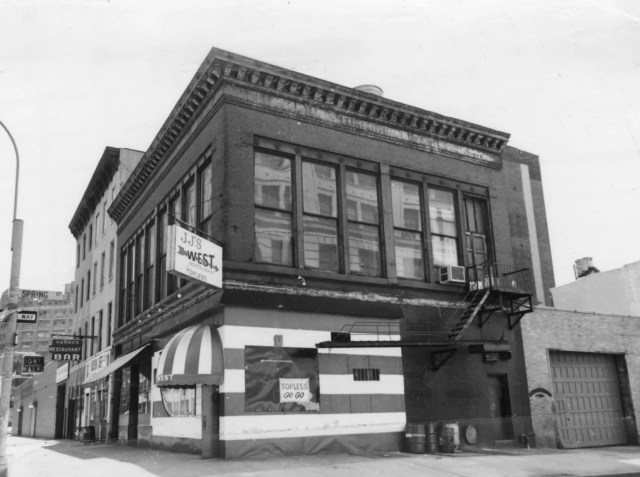


289 Hudson St / Spring St., like most other buildings in the SOHO / Cast-Iron district took on a life of its own. Sometime after the Half Note moved out in 1972, JJ’s West Restaurant and cocktail lounge moved-in. Sometime in 1974 it became a topless go go bar.
Through the 1980’s it seems to have been mostly abandoned but perhaps lingers longest in history as the outside of the “Berlin Bar” in Martin Scorsese’s After Hours [53]The scene can be seen here, right at the start – https://youtu.be/A-rs-kWL5-s?si=S36lhTvVMea24XHe – The location as well as other locations from this iconic film are covered in this … Continue reading
In the 1990’s it became Ellen’s Deli & Grocery and stayed that way for over a decade. In 2014, the deli was taken over and refurbished and opened in 2015 as DD Sprout Deli & Grocery. The deli was gone by 2022, and at least as of September 2024, possibly earlier, it had been completely demolished. Today a seven story, 73ft tall, 14,829 sqft building will provide 15 rental units and 1,710 sqft of commercial space and a cellar level. It would be great, but unrealistic to image the return of the Half Note [54]https://newyorkyimby.com/2025/09/289-hudson-street-tops-out-in-hudson-square-manhattan.html.

I can’t find the Canterino book online for sale or via the library service Prospector database. The one book that you can find that mentions the Half Note Jazz Club is the book about Disney/Pixar’s animated feature film “Soul” [55]The Art of Soul / foreword by Tina Fey; introductions by Pete Docter and Kemp Powers. – Chronicle Books – ISBN 9781452179810 (hardcover), 1452179816 (hardcover.
The film features jazz, written by Jon Batiste, early in the film – as well as scenes at the Half Note jazz club [56]https://www.radiotimes.com/movies/soul-soundtrack-pixar-disney-plus/. I have no idea why Canterino’s book wasn’t published; perhaps they sold the rights and Disney/Pixar blocked publication. It’s a shame since the original Half Note was unique in many ways, and its story needs to be told [57]There seems to be a version of the book online, but it’s not clear what’s happening with it https://thehalfnotejazzclub.com/
My Half Note Story
When I worked in Manhattan between 1983-86, the club location was mostly boarded up. I remember the first time I went late one evening in 1983 to see if anything was “happening” – I ended up at the Blue Note. [58]I still have in my backlog of articles partially written, a piece on 2000 Records and Greene Street, Creed’s last original project. As an outtake of that, I have a long piece on the “Cast … Continue reading
I did go to the Half Note in New York, though, just not the one in New York City. In the late 1980s, as an IBM software engineer who infrequently visited IBM Kingston, I went to the Half Note Cafe in Palenville, NY, a couple of times. Palenville was north of Kingston and just 12 miles from the town of Woodstock [59]Owned by former New York City firefighter John Bilotti – It was more bluegrass and rock, ala Woodstock, than jazz. The Woodbine Inn, on the corner of Malverne/Woodstock Ave., has replaced the … Continue reading.
Weirdly, this part of New York state was humming with small clubs, not because of Woodstock’s notoriety but because they were on the route to/from Montreal and New York City, with Rochester nearby. The Harbor Lights Club in Monroe, NY on Route 9W was a regular stopping point. Bill Evans and his trio, Al Cohn, Zoot Sims, and Chris Connor all played there.
Miles on the Ground, Miles in the Air
Jazz owes a lot to miles, and not just Miles Davis. In retracing the journeys of Wes Montgomery and Wynton Kelly, I am struck by how much of their artistry was carried on the back of relentless travel—endless nights on buses, in cramped cars, and the weary shuffle between one club and the next.
Their music soared, but their bodies endured the grind of the road. Three of the four men died young. By contrast, I have logged more than four million miles in the air, crossing oceans and continents with a speed and reach they could scarcely have imagined. Yet the truth is the same: whether by bus through the Midwest or by jet across the Atlantic, travel extracts its toll.
The fatigue accumulates, the hours blur, and the geography becomes a haze. What remains is the paradox that movement both enables and exhausts – the price paid for carrying sound, memory, and meaning from one place to another.
Travel is both the engine of discovery and the thief of rest.
[references]
UPDATES:
April 4th, 2026: Added table of contents, changed location of references.
References
| ↑1 | This quote is often attributed to a 2005 New York Times article; in fact, it appeared much earlier in the Detroit Free Press, Mon, Aug 10, 1987 issue on Pg 39 – https://www.newspapers.com/article/detroit-free-press-all-that-jazz-methe/181707242/ |
|---|---|
| ↑2 | Wes Montgomery: Live in ’65 / Reelin’ in the Years Productions; producers, David Peck, Philip Galloway, and Tom Gulotta. |
| ↑3 | https://en.wikipedia.org/wiki/Wes_Montgomery |
| ↑4 | https://en.wikipedia.org/wiki/Wynton_Kelly |
| ↑5 | https://en.wikipedia.org/wiki/Paul_Chambers |
| ↑6 | https://en.wikipedia.org/wiki/Jimmy_Cobb |
| ↑7 | Down Beat – June 17, 1965, Pg46 |
| ↑8 | Philadelphia Daily News – Mon, Jun 21, 1965 ·Pg33 |
| ↑9 | https://www.discogs.com/master/82211-Wes-Montgomery-Willow-Weep-For-Me |
| ↑10 | https://www.discogs.com/master/306725-Wes-Montgomery-The-Small-Group-Recordings |
| ↑11 | https://www.discogs.com/release/10291203-Wynton-Kelly-Trio-Wes-Montgomery-Smokin-At-The-Half-Note |
| ↑12 | https://www.discogs.com/release/27997104-Wynton-Kelly-Trio-Wes-Montgomery-Smokin-At-The-Half-Note |
| ↑13 | https://www.discogs.com/release/3026690-Wes-Montgomery-Live-In-65 |
| ↑14 | https://www.discogs.com/release/9407924-Wes-Montgomery-In-Europe-1965 |
| ↑15 | https://www.discogs.com/release/10420663-Wes-Montgomery-The-Wynton-Kelly-Trio-The-Unissued-1965-Half-Note-Broadcasts |
| ↑16 | https://www.discogs.com/release/4793503-Wynton-Kelly-Trio-Wes-Montgomery-Smokin-At-The-Half-Note |
| ↑17 | https://resonancerecords.org/product/wes-montgomery-with-the-wynton-kelly-trio-smokin%c2%92-in-seattle-live-at-the-penthouse-1966-cd/ |
| ↑18 | https://www.discogs.com/sell/release/33678129 |
| ↑19 | https://resonancerecords.org/shop/ |
| ↑20 | https://www.dougpayne.com/cti_pd.htm |
| ↑21 | https://www.discogs.com/release/3492437-Wynton-Kelly-Trio-Wes-Montgomery-Smokin-At-The-Half-Note |
| ↑22 | Downbeat July 1965, Pg 48 |
| ↑23 | Jazz Journal June 1969, Pg29 |
| ↑24 | it is “unknown” who the musicians were that played on the overdub session with Ogerman. If money and time were no object I’d go visit the AFM archives to see if I could make a match. |
| ↑25 | Downbeat Jan. 2012 Pg99 |
| ↑26 | It is worth noting that the March 10th issue of Down Beat – Reader Paul F. Macri pf Watkins Glen, NY – took reviewer Wilson to task over his treatment of Wynton Kelly noting among other things that “Perhaps in your recent obsession with the avant-garde, you forgot that a performer who plays chords, melody, and harmony can be very inventive, whereas one who honks, bleats, or plucks the strings of a piano is not necessarily an advanced jazz performer of great talent.” |
| ↑27 | https://www.discogs.com/master/990121-Gene-Pitney-And-Melba-Montgomery-Baby-Aint-That-Fine |
| ↑28 | https://web.archive.org/web/20220824135526/https://www.jazzwax.com/2022/08/creed-taylor-1929-2022.html |
| ↑29 | Modern Drummer August/September 1979 Pg30 |
| ↑30 | https://www.discogs.com/release/28975270-Wes-Montgomery-The-Complete-Full-House-Recordings |
| ↑31 | https://youtu.be/L8V0eYLBiJ0?si=-mPSXXKx0G7Y5DDu |
| ↑32 | The tracks in each set can be displayed by expanding the playlist, which also shows a download link for each set. |
| ↑33 | The full FM Radio Archive entry for these recordings is https://archive.org/details/wes-montgomery-live-in-europe-spring-1965 |
| ↑34 | https://www.youtube.com/watch?v=olSe_oyim5Q |
| ↑35 | https://www.discogs.com/release/6716050-Wes-Montgomery-Quartet-Booker-Ervin-Quartet-With-Chick-Corea-Live-At-Newport-67 |
| ↑36 | https://jazztimes.com/features/columns/john-levy-boss-bass/ |
| ↑37 | Down Beat – October 21st, 1965 – Pg41 |
| ↑38 | Down Beat – Dec. 2nd 1965 – Pg14 |
| ↑39 | Down Beat – December 16th, 1965, Pg16 |
| ↑40 | Down Beat – January 28th, 1965 Pg11 |
| ↑41 | New York Amsterdam News, Sat, Aug 26, 1967 ·Pg 42 |
| ↑42 | https://www.nytimes.com/1971/05/07/archives/apollo-audience-turns-on-black-troupe.html |
| ↑43 | https://youtu.be/kWAel-b9dI4?si=Kd3XiT1wJxc2L7lk |
| ↑44 | Billboard Dec. 26th, 1970 |
| ↑45 | Weirdly Long does not have a wikipedia page and their are no mentions of his bankruptcy in either the popular or music press. https://www.upi.com/Archives/1989/08/15/Theatrical-producer-James-Peter-Long-dead-at-66/6247619156800/ |
| ↑46 | https://www.seattletimes.com/seattle-news/seattle-jazz-broadcaster-reaching-fans-around-world/ |
| ↑47 | https://archive.org/details/wes-montgomery-wynton-kelly-penthouse-seattle-1966-kplu |
| ↑48 | https://jazztimes.com/reviews/albums/wynton-kelly-triowes-montgomery-smokin-seattle-resonance/ |
| ↑49 | https://www.discogs.com/master/1187873-Wynton-Kelly-Trio-Wes-Montgomery-Smokin-In-Seattle-Live-At-The-Penthouse- |
| ↑50 | https://album.link/s/4eaV0JjMCohCKvtP6Z2AVX |
| ↑51 | Cash Box – June 26th, 1965, Pg 7 |
| ↑52 | http://ctproduced.com/oklahoma-toad-dave-frishberg/ |
| ↑53 | The scene can be seen here, right at the start – https://youtu.be/A-rs-kWL5-s?si=S36lhTvVMea24XHe – The location as well as other locations from this iconic film are covered in this excellent reconstruction on NYC In Film https://nycinfilm.com/2021/08/06/after-hours/ – The complete film is well worth a watch. When I arrived in Manhattan to work in 1983, it really was pretty much just like this, north of Wall St and out in the East Village. The film is on some streaming services and can be seen in full on Youtube, at least here in the USA – https://www.youtube.com/watch?v=ceRfJ5-shXs – I will return to this area in a later post about Creed Taylor’s last releases and Green Street Records. |
| ↑54 | https://newyorkyimby.com/2025/09/289-hudson-street-tops-out-in-hudson-square-manhattan.html |
| ↑55 | The Art of Soul / foreword by Tina Fey; introductions by Pete Docter and Kemp Powers. – Chronicle Books – ISBN 9781452179810 (hardcover), 1452179816 (hardcover |
| ↑56 | https://www.radiotimes.com/movies/soul-soundtrack-pixar-disney-plus/ |
| ↑57 | There seems to be a version of the book online, but it’s not clear what’s happening with it https://thehalfnotejazzclub.com/ |
| ↑58 | I still have in my backlog of articles partially written, a piece on 2000 Records and Greene Street, Creed’s last original project. As an outtake of that, I have a long piece on the “Cast Iron District,” which today is all high-end fashion stores, expensive apartments, and more. Back in the 1980s, it was deserted and falling apart. |
| ↑59 | Owned by former New York City firefighter John Bilotti – It was more bluegrass and rock, ala Woodstock, than jazz. The Woodbine Inn, on the corner of Malverne/Woodstock Ave., has replaced the Half Note Cafe https://www.thewoodbineinn.com/history and the old house piano was signed “To The Gang at The Half Note” by Louis Armstrong’s bandsman Shorty Jackson. Bilotti sold the cafe and reopened the Woodstock staple “The Joyous Lake” in 1991 with, among others, Rich Fusco – former program director of WDST Woodstock. Today, the building is a restaurant, Slyvias on Mill Hill Road in Woodstock https://www.silviawoodstockny.com/. |
Discover more from Creed Taylor Produced
Subscribe to get the latest posts sent to your email.